Showing posts with label Hunter Valley. Show all posts

Saturday, July 21, 2018

John Howe... Could be the father of Robert John Howe Snr.

Searching searching searching and I find this at this following website.  I have copied it so that I can easily access this information. Sometimes sites go down and I have lost vital family research information.  If you have any ancestor connections to the Hunter Valley please avail yourself to the following website from which I obtained the information on John Howe.

https://www.jenwilletts.com/john_howe.htm

JOHN HOWE

John Howe arrived free on the Coromandel in 1802. He received a grant of 100 acres at Mulgrave Place dated 19 April 1803.

He became an auctioneer at Windsor and worked on road and bridge construction projects before being appointed Chief Constable at Windsor in 1814 and Coroner in 1821.

After the death of his first wife Frances, who had accompanied him to Australia, he married Jane Kennedy, daughter of James Raworth Kennedy.

EXPLORATION

John Howe received grants of land in the Hunter Valley after his expeditions in 1819* and **1820 to find an alternate route to the new settlements and to open up more grazing land to the north. In the Historical Records of Australia (Notes) the route taken is described .....

In October and November, 1819, John Howe, chief constable at Windsor, led a party from the Hawkesbury to the Hunter river, which followed in a general way the direction of the Bulga road. On the 26th of October, the expedition crossed the Colo river, a little above the junction of Wheeny creek. 
Six days later, after some difficult travelling, under the guidance of some natives, the party, keeping to the west of the Macdonald river, passed the neighbourhood of Yengo mountain, then crossed the upper Macdonald and encamped for the night on Wareng creek, at a spot a mile west of Wareng mountain. During this day, a party of about sixty natives were met, many of whom had never seen a white man. On the 2nd of November, the dividing ridge between the watersheds of the Hawkesbury and Hunter rivers was crossed, after finding it necessary to unload the horses to cross the hills. 
Two days later, a heavy fog, lying east and west, was observed from the top of some high rocks, and the presence of a river was suspected. 
On the following day, Friday, 5th November, the Hunter river was reached, a little above the present town of Singleton. The river was followed down for some distance, until the homeward journey was commenced on the following day. 
The return journey was accomplished after some difficulty in the rough country, and Windsor was reached after an absence of twenty-two days.
In a letter, dated 17th November, 1819 John Howe reported the result of his journey to Governor Macquarie.

On the 5th of February, 1820, a second expedition under Howe's leadership left Windsor, and spent five weeks in the examination of the valley of the upper Hunter river . As a reward for his discoveries, on the 18th of September, 1820, John Howe was granted a license by Governor Macquarie to graze his flocks and herds at "St. Patrick Plains" (now Patrick's Plains), which he had discovered, and subsequently a grant of seven hundred acres of land, known as Redbourneberry, was made to him.

HRA, Series 1, vol. X p. 810. LAND GRANTS

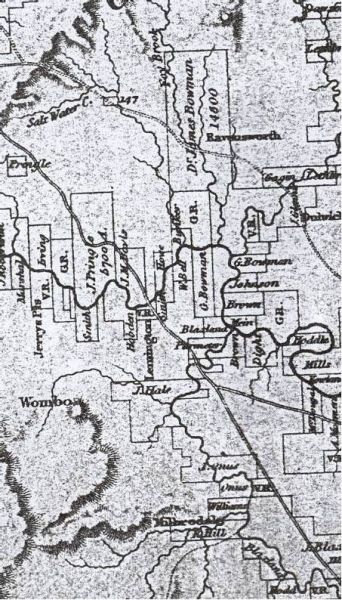
For his services on the expeditions he was granted 700 acres of land. The town of Singleton embraces the great portion of it. Howe called the estate Redbourneberry, after his native town in Lincolnshire England. (centre on map below)

In 1824 John Howe was granted an additional 500 acres in the Parish of Ravensworth which he named Mibrodale (lower centre on the map below).
In 1839 he moved to Raworth near Morpeth. This land had been a 200 acre grant to James Griffiths in 1823.
His estates at Patrick Plains were managed by his family. John Howe died at Raworth in 1852 and was buried in the Cemetery at Morpeth.

 NOTES AND LINKS
1. On John Howe's expedition which departed 24 October 1819 he was accompanied by George Loder junior, John Millward, John Eggleton (or Egleton?), Charles Berry, Nicholas Connelly and two native guides.

On the March 1820 Expedition he was accompanied by: George Loder junior (free)1st and 2nd expedition Benjamin Singleton (free) Daniel Philips (free) arrived per Matilda 1791.
 Jeremiah Butler arrived Earl Spencer Ticket of leave holder. Samuel Marshall arrived Ocean in 1816. Nicholas Connelly arrived Guildford 1816 1st and 2nd expedition. Frederick Rhodes per Fame James House per Batavia.
Robert Bridle per Batavia, Andrew Loder volunteer, Thomas Dargen junior volunteer, Philip Thorley volunteer Myles and Mullaboy natives - These two men actually guided the expedition, having been sent out beforehand by John Howe to locate an elderly aborigine who had told of a better route than the one previously found.

2. Interesting Memoirs - Ebenezer, Portland and Windsor Pioneers - Windsor and Richmond Gazette 11 November 1921
Wednesday, July 18, 2018

CONVICT or FREE PASSAGE

Quite often I am drawn to spend time continuing my research on our extensive family history.  I recently came across this web page that allows you to search for free any ancestors who came upon the area known as the Hunter Valley.

Free Settler or Felon?
I have found this a very helpful tool indeed and I would like to share this with my readers.  It was so helpful  because I have found a mass of information that may relate to my Great Great Grandmother's (Louisa Sarah Stokes) second husbands family who was Mr Robert John Howe from Jerry's Plains and later of the Warwick Queensland area.

I've found a Howe Valley and a Howe Creek and an interesting article about a Mr John Howe which could be Robert John's father.  This was all very close to Jerrys Plains in the Hunter Valley and at the correct time which I am searching. 

Robert John Howe in Warwick spoke about when he was at Plymouth for a picnic for soldiers, because he was born in Australia - I now have to find if he traveled back to England with his father and is this how he was able to speak of this picnic when in his words "I was quite a little chap at the time"

Screenshot (278).


  The Free Settler or Felon database is an on-going project. There are over 180,000 references to people and places in Newcastle and the Hunter Valley.  
Search Free Settler or Felon to find your Hunter Valley Ancestor.


Wednesday, April 30, 2014

Can you beleive it? Rio Tinto still want to extend the open-cut coal mine near Bulga NSW.

A defiant Rio Tinto are still attempting to push ahead with the extension of the open-cut coal mine near Bulga in the Hunter Valley of New South Wales.   


SAM 8413.1 Knitting Nana Sting at the Rally
Sydney Law Courts
Multinational mining company Rio Tinto is defying the verdict of the Supreme Court which upheld the earlier decision by  the Land and Environment Court to not allow for the Mt Thorley Warkorth mine extension. 

Bulga is a beautiful little village, a tiny haven of 350 people who sadly reside at the gate of the Hunter Valley Mine Expansion program of New South Wales, Australia.

The Supreme Court verdict did not seem to faze Rio Tinto.  They say they are simply going to submit another development application under the new controversial planning laws and attempt to steam roll this through regardless of the process of law.

Last year when Planning minister Hazzard took no notice of the Land and Environment Court decision and sided with Rio Tinto against the people, it left many people in New South Wales with no other option but to see the reality of the political arena today.   The arena is clearly a corrupt and filthy paddock of play with no place for the views of the people or the courts, it is the haunt of of the corrupt, the greedy and the inhumane.

Rio Tinto saying no matter what we will still go ahead despite the ruling is "Genocide via Ecocide".

The supreme court cited the expected economic benefits of the expansion did not justify its environmental impacts.  Residents have already been driven mad with dust and particulate issues that Rio Tinto already do nothing about.  The noise is already deafening and any thought of doubling this is just not justifiable.

SAM 8391
Bulga Residents Protesting at the Law Courts in Sydney
 If allowed to proceed, Rio Tinto  will destroy the land that was previously set aside as compensation.  This set aside land contains endangered eco systems and it was clear at the onset this land was compensation for the earlier destruction of land compliments of the present mine at Warkworth near Bulga NSW. 

To even entertain such a notion about the set aside land is not ethical business and it is a clear misrepresentation of the the parameters of truth presented to get the earlier Development Applications.

This type of thinking is not logical or practical as there are no long term benefits in such short term thinking.
Demand Rio Tinto respects the rulings of both the Supreme and NSW Land and Environment Court.
Please sign the petition and tell mining giant Rio Tinto not to extend its polluting open-cut coal mine.   HERE  at Petition Site.  It may not be what stops it but it just might help.
Follow the story further with the ABC Here 

Judgment Summary Supreme Court New South Wales
Court of Appeal  7 April 2014
Warkworth Mining Limited and Anor v Bulga Milbrodale ProgressAssociation Inc [2014] NSWCA 105
Bathurst CJ, Beazley P and Tobias AJA

Images @ Eminpee Fotography
Enhanced by Zemanta

Thursday, April 24, 2014

What about Cessnock NSW .. Gateway to the Vineyards.


IMG 8435 C

Cessnock is a city in the Hunter Region of New South Wales, Australia, about 52 km by road west of Newcastle.  Cessnock was named after an 1826 grant of land called Cessnock Estate, which was owned by John Campbell.
Greater Cessnock contains a number of buildings and sites that are on the Register of the National Estate.
  • Court House, Branxton
  • Police Station and Residence, Branxton
  • Former Court House, Greta
  • Kurri Kurri Hotel, Lang and Hampden Streets, Kurri Kurri
  • Richmond Main Colliery, Mulbring Rd, Pelaw Main
  • Laguna House, Laguna
  • Post Office, Wollombi
  • Endeavour Museum (former Court House), Wollombi
  • Public School, Wollombi
  • St Michael's Catholic Church, Wollombi
  • St John the Evangelist Anglican Church, Wollombi
  • Stanford Main No.2 Colliery Pit Head Building, Brick Cottages
  • Aboriginal Rock Carvings Site, popularly known as Baiame Cave, Milbrodale Area 
  • This area is the traditional lands of the The Darkinjung peoples.
The Baiame cave is outside the village of Milbrodale in the Lower Hunter Valley, not far from the town of Wollombi. It is close to Bulga, the site of an Aboriginal ceremonial bora ground, the place where boys were initiated into manhood. The Bulga bora has been described as being of ‘immeasurable significance’ by the NSW Department of Planning. 
 
 Baiame is the creator spirit of the Dreaming of the Aboriginal peoples of South-Eastern Australia, including the Wonnarua, Wiradjuri, Darkinjung, Awabakal, Worimi and Kamilaroi.
The first European references to Baiame date from the 1820s and 1830s and appear in the accounts of missionaries and white ‘explorers’. There are many variations in the spelling of his name.

What is it about Cessnock,  I know a lot of people from there.  Its an old mining town and it shows too and the smell of the coal is very evident everywhere you go.  The main street is a classic very long one that seems to stretch on forever but now boasting many empty business places.  The street looked tired for such a rich mining area.

The other day two men from here lost there lives in a mine collapse and the locals are in shock, although they all ought to realize they take their lives in their own hands each time they go down.  These miners go down kilometers under the ground. Its a terrifying job I would not want my husband doing this work for all the gold in China.

IMG 8461 Pit Houses
Pit Houses in Cessnock
There are funny little houses they call pit houses in the surrounding areas of Cessnock.  My daughter and her partner live in one of these little houses.  They are the cutest houses going.  They are probably tiny inside though.

IMG 8459 Pit Houses
Half Round Pit Houses in Macquarie Avenue Cessnock

Images @ Eminpee Fotography
Enhanced by Zemanta

Sunday, April 20, 2014

No Horse Stud for the Sheik ... sickened by the ravaged landscape of the coalfields.

 British thoroughbred breeder David Redvers is looking to establish a new stud in the Southern Hemisphere for Qatari Sheik Fahad Al-Thani.  The Hunter Valley was on the definite short list.

IMG 5645

He flew over the Hunter region last week and after witnessing the shocking site of the Hunter Vally coalfields, Mr Redvers changed his plans with a complete about face ,he said he'll now be looking to establish the stud in either New Zealand or Victoria.

Redver's doesn't believe  mining and agriculture is an example of co-existence, he was horrified to see the close proximity of these industries to each other.

David Redvers said:
"Firstly, I was surprised by just how green it was and that turned to shock and sadness at seeing just how huge the scale of destruction is there of what is prime country."
Images @ Eminpee Fotography
Enhanced by Zemanta

Monday, February 10, 2014

Government Corruption over Coal Dust particle levels.

Each day we examine papers, emails, correspondence where we can to keep up with the collusion of government with the mining sector and the involvement of other industries with this.


IMG 5257
Quirindi trains.

Yesterday Glen Shaefer via the Hunter Community Environment Centre discovered some huge inconsistencies and a systemic cover up by a detailed examination of   the figures regarding the coal dust particulates and  emissions. 

The Freedom of Information act gives us all access to these emails.   The HCEC carefully sieved through methodically noting the inconsistencies.  HCEC spokesman James Whelan says the documents show the EPA prepared a draft press statement that stated the coal trains did not increase pollution before the agency received the monitoring results.

''There has been a systematic cover-up that warrants a parliamentary inquiry,'' Dr Whelan said.
 ''The documents demonstrate a public relations effort of deception and spin to conceal the extent and nature of pollution caused by uncovered trains.''
''The documents demonstrate a public relations effort of deception and spin to conceal the extent and nature of pollution caused by uncovered trains.''

Luke Foley who is the opposition Environment spokesperson has noted the Environment Protection Agency (EPA) is more concerned with colluding with the polluters than protecting the communities and their health concerns.

''If the minister has unknowingly misled the Parliament as a result of false advice from the EPA, she must correct the record immediately,'' Mr Foley said. ''And she needs to put a broom through the EPA.''
Then there was the  inevitable statement made by Environment Minister Robyn Parkin  which says she stands by the figures and that the  statements were made on the latest advice of her departments.

EPA chief executive Barry Buffier had an identical approach to Parkin and funnily enough he takes the same tac and also  stands by all EPA statements that have been released concerning the  covering of coal wagons.   

An independent expert, Professor Louise Ryan of UTS is reviewing all of the data and this report is also due to be released later in February this year.

A statewide campaign to cover up these coal trucks has been initiated by ordinary people who are seriously concerned with the health impacts people are made to endure.  They want these wagons covered up.  

This will cost these colluding companies a lot of money they never wanted to spend.  Why? 
Because they do not give a dam about peoples health in reality.  This same "in your face" attitude is reigning through all of the mining industry at present in this country.  Ordinary people who pay taxes are not listened to over large company profit margins.

The documents that were viewed clearly show the EPA had prepared a very premature media statement in advance before the results of the studies were viewed by Professor Wayne Smith of the NSW Health Department and before his report was prepared. 
 The drama has ensued over  coal trains that haul tonnes of coal in uncovered wagons from Hunter Valley mines to the Newcastle port.   They are licensed polluters.  This is the  federally owned Australian Rail Track Corporation.

Images @ Eminpee Fotography

Friday, December 20, 2013

NSW Refuses to release the information on who lobbied who!

RIO TINTO got its approval for the mine expansion in the Sleepy hollow of BULGA in the Hunter Valley and then it was overturned by the courts. The company went into panic mode and they and the low life NSW Government entered an appeal against the decision that had been brought down.

>

 Who did this lobbying for the Government. My guess is Wells Haslem is probably involved from what I can tell by who are the board members, none other than Mining boss and ex senate leader Mr Kerry Sibra for a start.

Then this week I read that there has been civil action to release information under the POI Act and the government has refused.   I hope the people keep the pressure on because the cracks are well evident.

Images @ Eminpee Fotography
Enhanced by Zemanta

Monday, September 16, 2013

Irrevocably altering the Australian landscape!

Coal and gas mining in Australia

The Australian Institute! 

Upper Hunter Valley Coal Mines - View to NW - 3
Detailed panoramic view looking west across part of the Upper Hunter Valley coal mining complex.

Author: 
The Australian Network of Environmental Defender's Offices
Posted on:
21 August 2013
Mining has always been an important part of the Australian economy.
What has changed is the unprecedented scale and pace of its expansion. This is already irrevocably altering the Australian landscape and affecting food production, water security and communities across the nation.

The coal seam gas fields approved to date in Queensland will cover tens of thousands of square kilometres with an industrial grid of wells, pipelines, roads and water treatment plants. They will feed three huge gas processing plants being constructed within the Great Barrier Reef World Heritage Area on Curtis Island. There are proposals to increase this threefold.

Australia is already the second largest coal exporter in the world, but with a series of “mega mines” there are plans to significantly increase the amount of coal we mine and export within the decade.
These huge projects are staggering in size. No one visiting Central Queensland or the Hunter Valley in NSW would be left in any doubt that they are transforming Australia’s rural landscape. However, it is the impacts that we don’t see that are often the most serious.

Coal mines and coal seam gas drilling disrupt aquifers that are essential to farmers and the natural environment. Coal mines are known to have discharged large amounts of contaminated water into our river systems, and no-one knows what to do with the huge amounts of contaminated water and salt that result from dewatering coal seams for gas drilling.
The human health impacts of coal are well documented and greenhouse gases that result from burning Australian coal and gas are a major contributor to climate change.

While these impacts are primarily social and environmental, they are also fundamentally economic issues. Industrialisation of rural areas directly impacts on the agricultural and tourism industries, and damage to the environment and people’s health is ultimately paid for by the community.

The Australia Institute has always been concerned with a broad range of economic, social and environmental issues that are essential to Australia’s future. All of these are impacted in a multitude of ways by Australia’s coal and gas expansion.

State governments have had the primary responsibility for managing resource development in Australia, but have failed to find an appropriate balance between the interest of the mining industry and the rest of the community.

These activities will have a profound impact on all Australians for many generations. As such, we believe it is time to look carefully at how the Commonwealth government can protect our food, water, environment and communities.

The policy question that always motivates The Australia Institute is ‘what should be done?’ Over the past three years we have published dozens of research papers which highlight the economic, social and environmental consequences of the unprecedented expansion of the fossil fuel extraction industry. We are proud to publish this research by the Australian Network of Environmental Defender’s Offices to help start the conversation about what we need to do about it.

DOWNLOAD TB 24 Coal and gas mining in Aus..pdf


IMG 3781
Leanne and Manja not really concerned with the world here.


Images @ Eminpee Fotography
Enhanced by Zemanta

Sunday, August 25, 2013

How safe is anything anymore?

A leading geologist is warning that BHP's long-wall mines are damaging Sydney's water catchment zones reducing the drinking water available for nearly a million people.

Photo: The NSW Govt has been allowing Coal Longwall Mining to devastate Sydney's Drinking water catchments. THIS STORY WILL GO TO AIR TONIGHT Friday 30 August 7.30pm, ABC1 (NSW Stateline). This is relevant to everyone in NSW, as it shows the primacy of mining over every other value.
Photo from Csg Free Northern Rivers

AUS NSW DSC04841
Photo by Brian Yap

Beautiful places in the Hunter Valley just north of there is also suffering the same fate with large fissures appearing in rocks where there were not large fissures like this before and the locals are saying it is the mining that has caused this because of the water. http://www.theherald.com.au/story/1735241/mine-subsidence-devastates-sugarloaf-video-photos/?cs=305

Images @ Facebook and Brian Yap
Enhanced by Zemanta

Tuesday, April 30, 2013

Tasman Sea under threat from mining activities near Gloucester NSW.

A silent war is going on and people drink at a hotel named after a local river which is under serious crisis. The council is not seeing this. The infrastructure should never have started here. 

The local people were smothered with double talk.  In this case the end does not justify the means.  Yes the town needs employment but it doesn't need mining jobs.  These companies use their own people mostly and there are usually only a few contract positions for a short time.

IMG 9781 The Avon Hotel
Avon Hotel.   Named after the Avon River.
Avon River is lovely and it is  a perennial stream of the Manning River catchment, is located in the Upper Hunter region of New South Wales, Australia.

The Avon River rises in the northern foothills of the Barrington Tops, south of Carsonville, and flows generally north-east, joined by five minor tributaries, before reaching its confluence with the Gloucester River, near Gloucester, south of the confluence of the Gloucester River with the Barrington River.

The river descends 412 metres (1,352 ft) over its 42 kilometres (26 mi) course. The catchment area of the river benefits from melting snow in spring. Gloucester district, although incredibly hot in the main summer months, nevertheless has an annual rainfall averaging 1,300 millimetres (51 in).  As a result, combined with the merging streams and rivers, periodic serious flooding occurs in theAvon Valley at Gloucester, sometimes cutting all transport links.
 
The Gloucester River eventually flows into the Manning River, a major waterway which flows into the Tasman Sea through a minor delta east of Taree.

IMG 9840 Gloucester area
Driving down the road we cross the Avon River just out of Gloucester
 In 2004, assessments of water sampling done in 1997 by the NSW Environment Protection Authority, revealed poor water quality, with high levels of nutrients leading to excess algae.

Along the river, downstream from Stratford, bank erosion and the invasion by exotic plant species have degraded the river.

AGL say the river isn't great now and wonders what our problem is regarding this.  This sort of unharnessed power with no conscious is quite a worry.  Mike Moraza who heads up Upstream Gas for AGL Gloucester Project cannot see the connection.  At Gloucester there is too much pressure to move on this project and the educated understanding of the geology has been laughed at and Professor Pell's has illustrated this to AGL.

Images @ Melonpopzdropz  Flickr

Sunday, November 11, 2012

The Downfall of the True Occult - Catholism in Australia..


IMG 3003 St Mary's Catholic Church Bellingen NSWThe sexual, physical and emotional abuse of children by the priests and clergy of the Catholic Church have long been known to occur.  I have known people from my own childhood in the care of the government of Queensland.  There were many many horror stories. 

Now the O'Farrell Government of New South Wales has called for an investigation into the church and they are calling for the terms of reference to be widened to take in the entire Catholic Church of Australia.  Instead the Government have bowed down to the church once again and have now switched tac's and are now trying to ask for an inquiry into the Police who were investigating the allegations of abuse.

This is outrageous and together with the mining issues the government has this will bring about a complete uprising in the peoples hearts.  You cannot do this to abused people like they are those sheep sent to slaughter in Pakistan recently.  These are people with thoughts and feelings and by negating every single one of these by switching from the investigation of the Church to the investigation of the Police is reprehensible to say the least. 

St Mel's Catholic Church, Narrandera, New Sout...
St Mel's Catholic Church, Narrandera, New South Wales, Australia (Photo credit: ausgenjourneys)

From the AM Program

NSW Govt criticised over abuse inquiry

Emily Bourke reported this story on Saturday, November 10, 2012 08:08:00
ELIZABETH JACKSON: The New South Wales Government's decision to establish a special commission of inquiry into the police, rather than the Catholic Church, in relation to allegations of sexual abuse by priests, has been labelled a decoy.

The announcement of the inquiry by the New South Wales Premier came in response to explosive allegations by a senior detective who claimed the church actively and systematically hampered police investigations into pedophilia in the New South Wales Hunter region.

This morning there are renewed calls for the resignation of Catholic Cardinal George Pell and a nationwide Royal Commission to investigate decades of sexual abuse of children and alleged cover ups by the Catholic church.

Emily Bourke reports.

EMILY BOURKE: The New South Wales inquiry will look at how police handled claims of sexual abuse by priests in the Hunter region after a senior detective detailed allegations of a cover-up by the Catholic Church.

Nationals MP Troy Grant welcomes the special commission of inquiry but he says it's not enough by itself.

TROY GRANT: This inquiry is not the golden panacea to address the broader issues about the Church's response to paedophilia, or their lack of response, and inappropriate response, and their actions to thwart investigations or to interfere. That is most definitely the domain of a national Royal Commission in my view.

EMILY BOURKE: As a police officer in the 1990s, Troy Grant led an investigation in the Newcastle area that uncovered the abuse of 35 people.

He says the leadership of the Catholic Church remains unaccountable.

TROY GRANT: The behaviour of the Church has been consistent back in the 70s right through to the mid-2000s, which is why I've called for the leader of the Catholic Church, Cardinal Pell, to fall on his sword.

He should've and could've done more and done better. I think he's lost the moral right to decide whether the Church's response is now appropriate.

That should be left to a Royal Commission.

EMILY BOURKE: But Troy Grant says a state-based Royal Commission would be half-hearted.

TROY GRANT: The country owns this problem.

These offenders have been moved. There's been a systematic process of them being moved from parish to parish, from state to state, from country to country.

The states do not have the capacity to properly investigate that to get to the bottom of this problem, it has to be at a national level.

EMILY BOURKE: But Frank Brennan, a leading human rights lawyer and Professor of Law at the Australian Catholic University, disagrees.

FRANK BRENNAN: I think a Royal Commission has become something of a platitude.

I think to have a specific inquiry at this stage in relation to the events at Newcastle is helpful in that it helps to focus on an area under diocese where there's obviously been considerable trouble. And to try and get clarity about an appropriate way forward there might then give lessons for other places and for the future.

My concern still about a Royal Commission as such, particularly at a national level, would be that it would be such an open-ended process that whether or not you'd get the same learnings, I just don't know.

EMILY BOURKE: During her trip to Bali this week, the Prime Minister was asked whether it was time for a proper inquiry.

She expressed her concern about the issue but said she'd review the latest revelations when she returns to Australia.

JUDY COURTIN: A Royal Commission is a bit of a no-brainer and should be non-negotiable.

EMILY BOURKE: Judy Courtin is a Melbourne-based lawyer who is researching abuse within the Catholic Church and its response.

JUDY COURTIN: The reasons for a Royal Commission have existed for decades.

What's different now is that there is, after many decades of hundreds and hundreds of people trying to do something about these crimes, finally these victims are being heard, they're being listened to.

I think there is an extraordinary amount of momentum growing for a Royal Commission, and I don't see that there's any other way out.

ELIZABETH JACKSON: Judy Courtin, a Melbourne-based lawyer, ending that report from AM's Emily Bourke.

And we have attempted to contact George Pell this morning and invited him to appear on Saturday AM, but so far our calls haven't been returned. 

 Images @ Melonpopzdropz Flickr


Enhanced by Zemanta