Showing posts with label Fishing. Show all posts

Wednesday, January 07, 2015

Ngunnhu Fish Traps near Brewarrina.

Fish Trap on the border of the two declared Independent 
Nations on NSW and Queensland border of
the Murrawarri Republic and the Euahlayi 
Peoples Republic (Image: Andrew Hull)


An Ancient Site in Australia's Outback


On the edge of the New South Wales outback, an ancient site reveals the ingenuity of Australia's first peoples
Ian Neubauer DestinAsian magazine (link is external) 26 December 2013
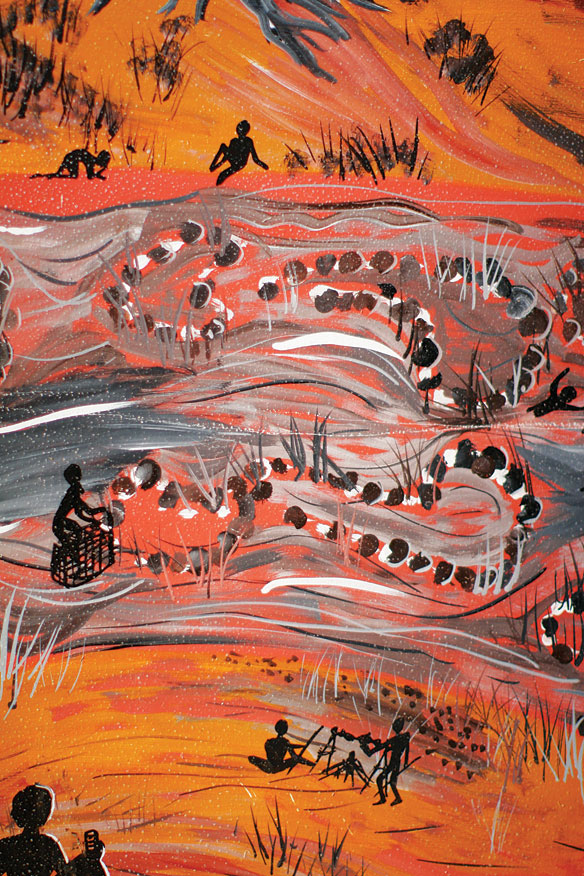
Mural on the wall with other paintings at the Brewarrina site 
on the Border of Murrawarri and Euahlay nations
(Image: Andrew Hull)
Ask 10 different people what they think is the oldest surviving manmade structure on earth and chances are you will get 10 different answers. The pyramids of Egypt or Central America? Not even close. Stonehenge? A relative newcomer. The Neolithic farmhouses of the Orkney Islands, or the megalithic tombs of France? At 7,000 years of age, the oldest of these barely registers alongside the granddaddy of them all—the Ngunnhu fish traps of Brewarrina.

A complex network of river stones arranged to form ponds and channels that catch fish as they travel downstream, the traps are said to date back at least 40,000 years. Fittingly, they are not found in such purported cradles of civilization as the Fertile Crescent or the Indus Valley, but on the world's oldest continent: Australia.

Stretching across a shallow bend in the Barwon River on the outskirts of Brewarrina, a dusty outback town 800 kilometers northwest of Sydney, the Ngunnhu (pronounced "noon-oo") fish traps reflect an ancient genius in the simplicity of their design, which was adaptable to the seasons and changing water levels. Archeologists say that the Aboriginal peoples who built them possessed advanced knowledge of water ecology, animal migration, geography, and engineering. But according to oral history, the fish traps (and the technology behind them) were inspired by nature—by the pelican, to be exact.

"There was a long drought and the people were suffering from famine," says Michael Anderson, an Aboriginal elder and educator. "But they were saved by the pelican, which showed them how traps work by using its large beak to scoop fish out of the river. After that, the pelican became a sacred creature. If anyone hurt or killed one, that'd be the end of them. They'd be dead before they got a chance to eat it."

But the punishment could not be carried out on the riverbank, as the area was considered sacred by the many tribes that jointly benefited from and maintained the fish traps for tens of thousands of years. "This was a place for feasting, marriage, dancing, and negotiating. Fighting was not allowed," Anderson says. "It was the Aboriginal equivalent of the General Assembly of the United Nations."

Enlarge Image
Fish Trap Portrait View
(Image: Andrew Hull)
The story of the Ngunnhu fish traps and their traditional custodians is told by a storyboard comprising traditional Aboriginal murals and written stories transcribed onto a low-lying concrete wall above the Barwon's south bank. "All families had a responsibility to maintain the trap," reads the first installment of the story. "When floods moved the rocks, families would put them back in place. When it flooded, the old men rushed to block the entry of the traps, herding the fish through the pens."
Farther down the wall, visitors learn about the calamitous events that followed the arrival of European settlers in 1840. The interlopers displaced the Aboriginal people and brought cattle and sheep to graze the land. They drove steamboats down the Barwon and introduced European carp, both of which mudded and polluted the river. When the Barranbinya tribe resisted, they were met with deadly force.
"The Ngemba, Murriwarra, Paarkinji, Weilwan, Ualari and Kamilaroi people/clan would like to take this opportunity to remember the Barranbinya people who were massacred by Europeans approximately 20 kilometers north of Brewarrina on the Goodooga Road near Hospital Creek in the 1860s," reads a dedication on the wall. "It has been suggested that only two members of this clan of over 100 survived."
In the 1870s, a thriving wool trade brought "civilization" to Brewarrina: banks, the telegraph, rows of hotels, steamboats, and the railway. Yet the fish traps remained undisturbed until the late 1960s, when a concrete weir was erected 50 meters upstream to ensure a steady supply of water for the drought-prone region. But the weir also made it difficult for fish to swim upstream to spawn, spelling disaster for the functional use of the world's oldest remaining structure.

"I remember when the weir wasn't there," says Aboriginal Heritage Officer Philip Sullivan. "We would wade across the river, dive in and have a swim. But the weir changed the entire dynamics of the riverbed. The banks are too high—you can't swim across certain parts of it—and the water pouring over the weir is noisy like a waterfall."

Sullivan adds, "I understand the reasoning behind it, because now the town won't run out of water. But if Aboriginal people had been consulted, we never would have approved the weir. Ngunnhu is a very special place to us, where ceremonies were held, a place of gathering not only for people but for pelicans and all the other birds that depended on the river for survival."

In 2012, authorities sought to rectify some of the ecological damage caused by the weir by building a stone fish ladder that enables fish to reach their spawning grounds upstream. And while the days when fish were plentiful in the Barwon are long gone, the development has seen the Ngunnhu fish traps come back online. On weekend mornings, you can spot children pulling Murray cod as long as their arms from the water, as well as perch, catfish, and black bream, the Barwon's best eating fish.

"The health of the river is a reflection of who we are," Sullivan says. "If the fish traps are empty, it means the country is in a bad way. But if there are lots of fish, then we must be doing something right."

This article originally appeared in the December 2013/January 2014 print issue of DestinAsian magazine ("A River Trapped in Time")

More: http://nationalunitygovernment.org/content/ancient-site-australias-outback

Saturday, June 15, 2013

Fish actually fell from the sky over Lajamanu in the Northern Territory

IMG 5755 

Miles and miles and miles away from a river or the ocean and fish start falling out of the sky on top of you,  that is not an everyday thing.   What is even more amazing is that its happened two other times that has been reported in the news.  This happened not once, but twice, on Thursday and Friday afternoon around 6pm at Lajamanu, about 550km southwest of Katherine.

In 1974  and in 2004 it occurred then and now its all happening again.  There were old reports in the NT News.  This made world news back then. 

Weather experts in Australia  are saying that this happens because the fish were sucked up in a thunderstorm before being dumped over the tiny town of Lajamanu with a population of 669 people.   The fish are believed to be spangled perch. 

When members of the community spoke to friends over on the coast they thought residents were losing the plot.  One lady said she hoped it didn't start raining crocodiles, cause that would be a worry.  All of the fish were alive as they hit the ground.

I wonder if they ate the fish?   I also wonder if they were tested to find out where they came from.  We may hear more about this yet.
Enhanced by Zemanta

Sunday, March 24, 2013

How Relaxing is Fishing?

IMG 9533 Tiny Fish
Montana's Tiny Fish (Bream)

Yellowfin Bream Acanthopagrus australis

Totally relaxing and I could fish and fish and fish.  Today we went down below my house here in Urunga and Anaan and Montana and I just fished for a few hours.    I caught the first fish of the day with a whiting, then another and then a bream and then another larger bream,  Montana and Anaan caught the same.
We pumped yabbies up from the under the sand and used these for bait.  I did a smashing job of  putting my own bait on.   I had to get serious because I am pretty fail at this usually.
For more information : FISHING and AQUACULTURE
Distribution - Yellowfin bream are found along the NSW coast, as well as in Queensland and Victoria. Bream inhabit estuaries up to the brackish water limit (the change from salt to freshwater) and inshore rocky reef habitats near ocean beaches and rocky headlands.
Size - Maximum weight of 4kg and a length of 60 cm.
Characteristics - Yellowfin bream have a silver to olive-green body with yellowish pectoral, ventral and anal fins. They are opportunistic feeders with their diet including small crabs, prawns, molluscs, pipis and small fish.
Confusing species - Black bream (Acanthopagrus butcheri) are found in NSW waters up to the Myall Lakes though are more common in Victoria and the south of the state. Yellowfin bream have a deeper body and a higher snout than black bream and have yellow ventral fins. Tarwhine have rounded, convex heads and a gold spot on each scale giving the fish a series of longitudinal bands. Tarwhine are found along the coast of New South Wales.

IMG 9560

Images @ Melopopzdropz Flickr

Thursday, July 19, 2012

Extinction Lists - 2012: Extinction lists 2012 update: Massive Fish kill wo...


 “Men! The only animal in the world to fear.” D H Lawrence

Extinction Lists - 2012: Extinction lists 2012 update: Massive Fish kill wo...: Extinction lists 2012 update: Massive Fish kill worldwide, mass death fish world wide 2012 | 2011 | 2010 | FAQ | Unconf...
Green Turtles -100

Green Sea TurtleGreen Sea Turtle (Photo credit: USFWS/Southeast)

QUEENSLAND, Australia July, 2012 Free Malaysia Today
"mysterious deaths of more than 70 green turtles that have washed up on beaches in northeast Australia over the last week"
These turtles appear to have nothing wrong because what is wrong is they are off course and they are completely lost.  If you were in the middle of the desert and you were prevented from ever finding home again you would just die in the end as well.
This to me is absolute proof that MAGNETIC NORTH HAS CHANGED DRAMATICALLY..

Sunday, March 04, 2012

No love, no friendship, can cross the path of our destiny without leaving some mark on it forever.

quote by Francois Mauriac

Fishing the river at Dawn

Everyone we meet or come across in our lives are the ones who help shape us as individuals during our journey of life.  If mud is thrown a little bit always sticks they say.  So even bad friendship leaves its mark on us and sometimes this is for a lifetime.

Men fishing with each other at Dawn in Urunga
 We are stereotyped into being a particular sort of person and it is difficult to break out of that.  In my opinion the difficulty lies with others though and not ourselves as its the others who want to keep us in the neat box they have placed us.  When we break out of the box things can be messy.  They can also be very exciting and liberating to the spirit.

For today, do something different and break out of the mould that others have you placed in and show them there are many sides to being a human being and that settling for just one is in fact boring.

Image by Mezza - Dawn fishing at Urunga March 2012
Enhanced by Zemanta

No love, no friendship, can cross the path of our destiny without leaving some mark on it forever.

quote by Francois Mauriac

Fishing the river at Dawn

Everyone we meet or come across in our lives are the ones who help shape us as individuals during our journey of life.  If mud is thrown a little bit always sticks they say.  So even bad friendship leaves its mark on us and sometimes this is for a lifetime.

Men fishing with each other at Dawn in Urunga
 We are stereotyped into being a particular sort of person and it is difficult to break out of that.  In my opinion the difficulty lies with others though and not ourselves as its the others who want to keep us in the neat box they have placed us.  When we break out of the box things can be messy.  They can also be very exciting and liberating to the spirit.

For today, do something different and break out of the mould that others have you placed in and show them there are many sides to being a human being and that settling for just one is in fact boring.

Image by Mezza - Dawn fishing at Urunga March 2012
Enhanced by Zemanta