Showing posts with label Plato. Show all posts

Thursday, October 22, 2015

Macrocosm and Microcosm

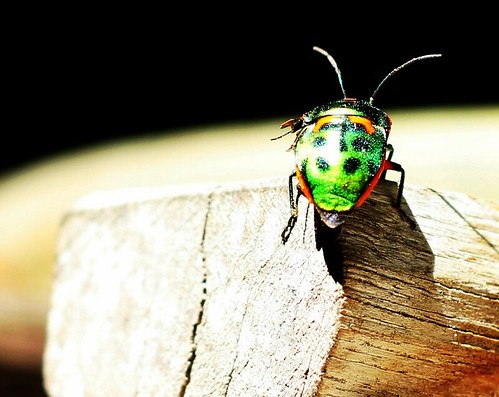
IMG 7901  Pretty Stink Beetle (Weevil)
Getting up close and personal with a pretty bug.

Watch this very short informative instructogram of the explanation of the simplicity of our world.


The natural processes of growth are variously influenced by magnetic energy both in man and the world around him.  The small mirrors the greater.  I often think that our eyes are like tiny universes and I have pondered often the water courses resembling trees and veins and that trees are very similar to placenta's in shape.  It is a level of consciousness that is in all is the All.

I first learned about the Macrocosm / Microcosm principal when my then husband and I were learning about "Mind Powers" from Kerry Riley and his wife in the early 1980's in Brisbane.  

I actively embraced conceptually that patterns are fulfilled without humanity even laying a finger on the growth.   When you understand this, it is then possible to understand the world on a different level and you understand the quickening that occurs both in a pregnant woman and the world waking up are but one and the same also.  It is but the divine process that is common to us all here in the universes.

"The beautiful orderliness of the universe is not only the manifestation of Intellect; it is also the model for rational souls to understand and to emulate. Such understanding and emulation restores those souls to their original state of excellence, a state that was lost in their embodiment."

Friday, June 12, 2015

Of Course Plato knew the truth.


 IMG 2182.1
"For many generations, as long as the divine nature lasted in them, they were obedient to the laws, and well-affectioned towards the god, whose seed they were; for they possessed true and in every way great spirits.." However, the Atlanteans became corrupt: "...when the divine portion began to fade away, and became diluted too often and too much with the mortal admixture, and the human nature got the upper hand, they then, being unable to bear their fortune, behaved unseemly, and to him who had an eye to see grew visibly debased" -  Plato, Critias 360BC
READ FULL STORY HERE :  ALANTIS REVEALED
http://www.ancient-origins.net/opinion-guest-authors/atlantis-revealed-platos-cautionary-tale-was-based-real-setting-003224

 Recent erosion and seismic tests at the Giza Plateau, indicated that the Great Sphinx may be much older structure than previously thought, and along with the site of Gobekli Tepe in Turkey, both seem to coincide with Plato's story of Atlantis.

Is it possible that Gobekli Tepe and the monument of The Great Sphinx could be remnants of the same advanced civilization Plato referenced in his story (Divine Race), one that was aggressively advancing against its neighbors in Africa and the Middle East, or do those belong to another culture?

And what about the advanced proto-Euphratean people who descended upon the Mesopotamia around 7000 BC, from a region "unknown."

Could these enigmatic people be the refugees of the same culture who fled the Mediterranean basin and moved eastwards to escape the inundation?

Undoubtedly, they could have brought with them the story of the great flood as well as the skills and technology to incite yet another great civilization, like that of ancient Sumer (just as the survivors around the Cyclades and neighboring islands may have ultimately contributed to the rise of the Minoans). 
Dee Smith Comment on ThyAlwaysseek.

 
Images @ Eminpee Fotograpy

Monday, June 08, 2015

Plato's "On the Soul".

IMG 2653
The souls of the dead must exist in some
place for them to be able to return to life
Plato's Phædo or Phaedo (/ˈfd/; Greek: Φαίδων, Phaidōn, Greek pronunciation: [pʰaídɔːn]), also known to ancient readers as Plato's On The Soul, is one of the great dialogues of his middle period, along with the Republic and the Symposium. The Phaedo, which depicts the death of Socrates, is also Plato's fourth and last dialogue to detail the philosopher's final days, following Euthyphro, Apology, and Crito.

The Cyclical Argument

Cebes voices his fear of death to Socrates: "...they fear that when she [the soul] has left the body her place may be nowhere, and that on the very day of death she may perish and come to an end immediately on her release from the body...dispersing and vanishing away into nothingness in her flight."

In order to alleviate Cebes' worry that the soul might perish at death, Socrates introduces his first argument for the immortality of the soul. This argument is often called the Cyclical Argument. It supposes that the soul must be immortal since the living come from the dead.
Socrates says: "Now if it be true that the living come from the dead, then our souls must exist in the other world, for if not, how could they have been born again?"
He goes on to show, using examples of relationships, such as asleep-awake and hot-cold, that things that have opposites come to be from their opposite. One falls asleep after having been awake. And after being asleep, he awakens. Things that are hot can become cold and vice versa. Socrates then gets Cebes to conclude that the dead are generated from the living, through death, and that the living are generated from the dead, through birth. The souls of the dead must exist in some place for them to be able to return to life

Images @ Eminpee Fotography

Tuesday, May 27, 2014

The Bembine Table of Isis

 
The Isiatic Table

A MANUSCRIPT by Thomas Taylor contains the following remarkable paragraph:
"Plato was initiated into the 'Greater Mysteries' at the age of 49. The initiation took place in one of the subterranean halls of the Great Pyramid in Egypt. The ISIAC TABLE formed the altar, before which the Divine Plato stood and received that which was always his, but which the ceremony of the Mysteries enkindled and brought from its dormant state.
With this ascent, after three days in the Great Hall, he was received by the Hierophant of the Pyramid (the Hierophant was seen only by those who had passed the three days, the three degrees, the three dimensions) and given verbally the Highest Esoteric Teachings, each accompanied with Its appropriate Symbol.
After a further three months' sojourn in the halls of the Pyramid, the Initiate Plato was sent out into the world to do the work of the Great Order, as Pythagoras and Orpheus had been before him."
Before the sacking of Rome in 1527 there is no historical mention of the Mensa Isiaca, (Tablet of Isis). At that time the Tablet came into the possession of a certain locksmith or ironworker, who sold it at an exorbitant price to Cardinal Bembo, a celebrated antiquary, historiographer of the Republic of Venice, and afterwards librarian of St. Mark's.
After his death in 1547 the Isiac Tablet was acquired by the House of Mantua, in whose museum it remained until 1630, when troops of Ferdinand II captured the city of Mantua. Several early writers on the subject have assumed that the Tablet was demolished by the ignorant soldiery for the silver it contained.
The assumption, however, was erroneous. The Tablet fell into the hands of Cardinal Pava, who presented it to the Duke of Savoy, who in turn presented it to the King of Sardinia.
When the French conquered Italy in 1797 the Tablet was carried to Paris. In 1809, Alexandre Lenoir, writing of the Mensa Isiaca, said it was on exhibition at the Bibliothèque Nationale.
Upon the establishment of peace between the two countries it was returned to Italy. In his Guide to Northern Italy, Karl Baedeker describes the Mensa Isiaca as being in the center of Gallery 2 in the Museum of Antiquities at Turin.
A faithful reproduction of the original Tablet was made in 1559 by the celebrated Æneas Vicus of Parma, and a copy of the engraving was given by the Chancellor of the Duke of Bavaria to the Museum of Hieroglyphics.
Athanasius Kircher describes the Tablet as "five palms long and four wide." W. Wynn Westcott says it measures 50 by 30 inches. It was made of bronze and decorated with encaustic or smalt enamel and silver inlay.
Fosbroke adds
"The figures are cut very shallow, and the contour of most of them is encircled by threads of silver. The bases upon which the figures were seated or reclined, and left blank in the prints, were of silver and are torn away." (See Encyclopædia of Antiquities.)

Friday, October 05, 2012

The highest form of pure thought is mathematics.

Plato - Ancient Greek Philosopher. He is reputed to be the world's most influential philosopher. 428 BC-348 BC.

SAM 8024 Pine Needles

What holds your world together?  Leave me a comment and tell me what does this in your world.  In my world it is a beautiful place where  Sound and unseen forces hold it all together for me.   Vibration and resonance at exact precise pulse moments is what makes my world the beautiful place that it is.  Sound and resonance.  We are beings of light after all.   Light has a resonance and so does colour.  So do we!

IMG 4534
These resonances have now been calculated to be mathematically perfect in the delivery.   Even in past times the word Rhetoric  meant far different to what it means to us  today.  It was the Art of the Orator, and these days we see it as the wordy exaggerated speech of politicians and the like.   We are left swindled and mildly off course.  This is the travesty left by the previous world education leaders ( The roman Catholics) for a little over two thousand years.

Imagine the use  of fibonacci in design schools if the truth was followed.  What beauty would come from the designs churned out by the students at will.  If only they knew.  They don't though because it isn't taught in our education systems.  Some person some where decided it was not important.  That person was a roman.  He was apposed to the general populace having true power and he desired to strip us and he did.

I am telling you  that this is important and if they won't teach you then you need to teach yourself.

Plato was a brilliant philosopher. He understood this connection we all share with everything else.  He understood we are the same as the stars in the sky and the ground we walk on and the waters of the oceans.  Our veins and rivers are similar and are the life blood of both entities of Earth and humanity.

The word "philosophy" comes from the Greek φιλοσοφία (philosophia), which literally means "love of wisdom". Plato was was a great lover of wisdom .  
Detail of The School of Athens by Raffaello Sa...
Detail of The School of Athens by Raffaello Sanzio, 1509, showing Plato (left) and Aristotle (right) (Photo credit: Wikipedia)
I love to quote Plato because he and I must have so many similarities and in fact he could have been a relative.  Because Fibonacci sequences ago, we may have even came from the same family.   A family of thinkers and lovers of natural beauty and aesthetics in nature. 

The perfection that nature offers up in everything.  The divinity of  it all just is a delight to see.  It is so plain to see.   It is everywhere around us.  It is in the petals of the flowers.  The separate seed pieces in the spiraling of a pine cone.   Our Pineal Gland is the first thing created from the sperm and egg when they combine to become life.  The fibonacci sequence is alive and well at the beginnings of life.  We have thirty three bones in our spinal cord.  Our bodies are walking mathematical showrooms of science and mathematics.  Perhaps Math and Medicine should be taken jointly.  After all  isn't God referred to as the great Physician. 

“There are two things a person should never be angry at, what they can help, and what they cannot.”

 These are wise words of Plato's.  He is so correct  and besides anger stems from fear and fear resonates lower and does nothing but sound like a gong.  Fear is not sweet.  It is rough and feels awful to hear  any fear resonance.  You hear it in shaky voices in shock.  This is a sound that makes my body go faster.  It makes my heart beat faster and my pupils dilate.

It is also not worth the anger at our leaders for teaching faulty education.  We need to take control for ourselves and do what we can to educate ourselves and our children in the sweet sciences of ancient times past.

Related Articles
Enhanced by Zemanta