What is the Bullroarer?

Mystical, Magical, Ancient, communications, Initiation, Ceremony, Musical and weapon. That is what a bullroarer is. That is what you call a very versatile piece of equipment.
So many cultures have bullroarers incorporated deeply. Is this more than a coincidence. The bullroarer was around for everyone. The swinging vortex above the users head. Creating a vortex anywhere is very powerful.
The bullroarer, rhombus, or
turndun, is an ancient ritual
musical instrument and a device historically used for communicating over
greatly extended distances. It dates to the
Paleolithic period, being found in
Ukraine
dating from 17,000 BC. Anthropologist Michael Boyd, a Bullroarer
expert, documents a number found in Europe, Asia, the Indian
sub-continent, Africa, the Americas, and Australia.
In ancient Greece it was a sacred instrument used in the
Dionysian Mysteries and is still used in rituals worldwide.
Scandinavia
Scandinavian
Stone Age cultures used the bullroarer. In 1991, the archeologists Hein
B. Bjerck and Martinius Hauglid found a 6.4 cm-long piece of slate that
turned out to be a 5000-year-old bullroarer (called a
brummer in Scandinavia). It was found in Tuv in northern Norway, a place that was inhabited in the Stone Age.
Britain and Ireland Scotland
In
Britain and Ireland, the bullroarer under a number of different names
and styles is used chiefly for amusement, although formerly it may have
been used for ceremonial purposes.
In parts of Scotland it was known as a
"thunder-spell" and was thought to protect against being struck by lightning
In Australia
Bullroarers have accompanied the didgeridoos in
initiation ceremonies and in burials to ward off evil spirits, bad tidings, and even women and children.
Bullroarers are considered secret men's business by some Aboriginal
tribal groups, and hence forbidden for women, children, non-initiated
men, or outsiders to even hear. Fison and Howitt documented this in
"Kamilaroi and Kurnai" (page 198). Anyone caught breaching the imposed
secrecy was to be punished by death.
They are used in men's initiation ceremonies, and the sound they
produce is considered in some indigenous cultures to represent the sound
of the
Rainbow Serpent. In the cultures of southeastern Australia, the sound of the bullroarer is the voice of
Daramulan, and a successful bullroarer can only be made if it has been cut from a tree containing his spirit.
In 1987, Midnight Oil included a recording of a bullroarer on their album Diesel and Dust (at the beginning of the song "Bullroarer") inadvertently causing offense to the Aboriginal people of Central Australia from whom the recording was taken.
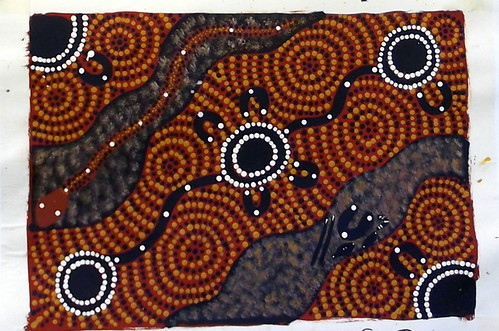
The bullroarer can also be used as a tool in Aboriginal art
Mali
The
Dogon use bullroarers to announce the beginning of ceremonies conducted during the
Sigui
festival held every sixty years over a seven-year period. The sound has
been identified as the voice of an ancestor from whom all Dogon are
descended.
Māori culture (New Zealand)
The pūrerehua is a traditional Māori bullroarer.
Its name comes from the Māori word for moth. Made from wood, stone or
bone and attached to a long string, the instruments were traditionally
used for healing or making rain
Native North American
Almost all the native tribes in North America used bullroarers in
religious and healing ceremonies and as toys. There are many styles.
Native South American
Amazonian Shamans, for example in
Tupi,
Kamayurá and
Bororó culture used bullroarers as musical instrument for rituals. In
tupian languages, the bullroaren known as
hori hori.
An interesting read from a book called Engendering Violence of Papua New Guinea by
Margaret Jolly,
Christine Stewart,
Carolyn Brewer. It can be found here at this link
This collection builds on previous works on gender violence in the
Pacific, but goes beyond some previous approaches to ‘domestic violence’
or ‘violence against women’ in analysing the dynamic processes of
‘engendering’ violence in PNG. ‘Engendering’ refers not just to the sex
of individual actors, but to gender as a crucial relation in collective
life and the massive social transformations ongoing in PNG: conversion
to Christianity, the development of extractive industries, the
implanting of introduced models of justice and the law and the spread of
HIV. Hence the collection examines issues of ‘troubled masculinities’
as much as ‘battered women’ and tries to move beyond the black and white
binaries of blaming either tradition or modernity as the primary cause
of gender violence. It relates original scholarly research in the
villages and towns of PNG to questions of policy and practice and
reveals the complexities and contestations in the local translation of
concepts of human rights. It will interest undergraduate and graduate
students in gender studies and Pacific studies and those working on the
policy and practice of combating gender violence in PNG and elsewhere.
Read here at Google Books