About Jackie Howe who is also related to me: He is my Great Grandmother Annie Chadbourne's half brother born to Jack Howe Snr when her mother Louisa married Jack Snr after the death by drowning of her first husband William "Billy" Chadbourne.
ECHOES OF THE PAST
JACKIE HOWE'S EXPLOITS
DAYS OF LARGE FAMILIES LLAMAS AT CANNING DOWNS
(By "Gooragooby." Dalveen.)
In December, 1848, when John Collins, stud groom at Canning Downs for the previous 40 years, surrendered the position on the eve of his entering into business as Warwick's first hotelkeeper in the newly erected Horse and Jockey Inn, at the corner of Palmerin and Victoria streets, and now the site of the Commercial Hotel, it was Billy Chadbourne, better known to the pioneers of his day as "Billy the Groom," who succeeded Collins as head groom on that historic station. Subsequently, Chadbourne married Miss Stokes, a young woman brought over from Sydney to be a help and companion for Mrs. George Leslie, then occupying the commodious shingled homestead at Canning Downs.
In course of time Mr. and Mrs. William Chadbourne were blessed with two children, a girl and boy, whom they named Annie and Willie. Then a sad calamity befell the humble home, for the father met his death by drowning near Jew's Retreat, endeavouring to swim the Condamine River when in flood early in 1854, the reason for his attempt being the registration of his infant son's birth within the regulation period. Chadbourne's body was recovered, and the interment took place on Canning Downs, midway between the homestead and the farm which was the site of the township's first necropolis.
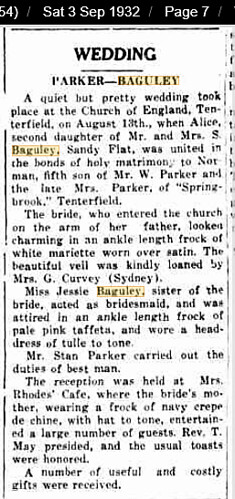
In after years Chadbourne's only daughter, Annie, became Mrs. William. Baguley. In those bygone days early marriages were the rule rather than the exception, and tradition has it that in 1869, when 17 years of age, Annie Chadbourne married, to be the mother of 15 children, nine sons and six
daughters, and when the call came, in 1931, she left 70 grandchildren and 38 great grandchildren.
My Great Grandparents .... William Adam Baguley married Annie Chadburne, they had fourteen children
their names were Henry, Catherine, William, Richard, Louisa, Annie,
Cecilia, James, John, Elizabeth, Mark (grandfather), Arthur and Leslie.
The BAGULEY
family married into these families... MOORE, PEGG, SHERRIN, OCHS, HART,
ROSS, FAY, HUNTLEY, ROWLING, BURLING, PETERSEN, THORNE, MATHISON,
BRADLEY, WARRENER, PEDERSEN, BRADBURY (my grandmother), TAYLOR, LAMB, MUNDEY, DORAN,
BROWNING, DEVLIN and GARDENER.
Her brother's (William Chadbourne's) family only totalled 13, three sons and 10 daughters, but between the two of them with 28 children, they certainly played their part in populating the Darling Downs.
About the year 1854 Billy Chadbourne's widow became the wife of Jack Howe, sen., acrobat and clown at Le Rosia's circus, which company he left some time previously when showing at Warwick. Howe's remaining days were spent in the town and district, where he found employment at bushwork, shearing, etc., and finally as town crier. At the time of the Queen's Jubilee functions at Warwick, in 1887, old Jack Howe, in commenting on the day, told a number of us boys that 50 years previously he attended a picnic to soldiers' children, given at Plymouth, England, in honour of Queen Victoria's coronation. He said he was quite a little chap at the time, but remembered the occasion quite well. When the Queen married Prince Albert he attended another picnic, which took place on a wet day.
A son of Jack Howe, sen. (the late Jackie Howe) was referred to in the Daily News last week, as follows
"Many wearers of the sleeveless singlet, which comes into its own during the hot summer months, wonder how that article of man's attire came by its popular name, Jackie Howe." A Warwick native, the late Jackie Howe's name is immortalised in that low necked, sleeveless flannel singlet he introduced to the shearing sheds over 40 years ago.
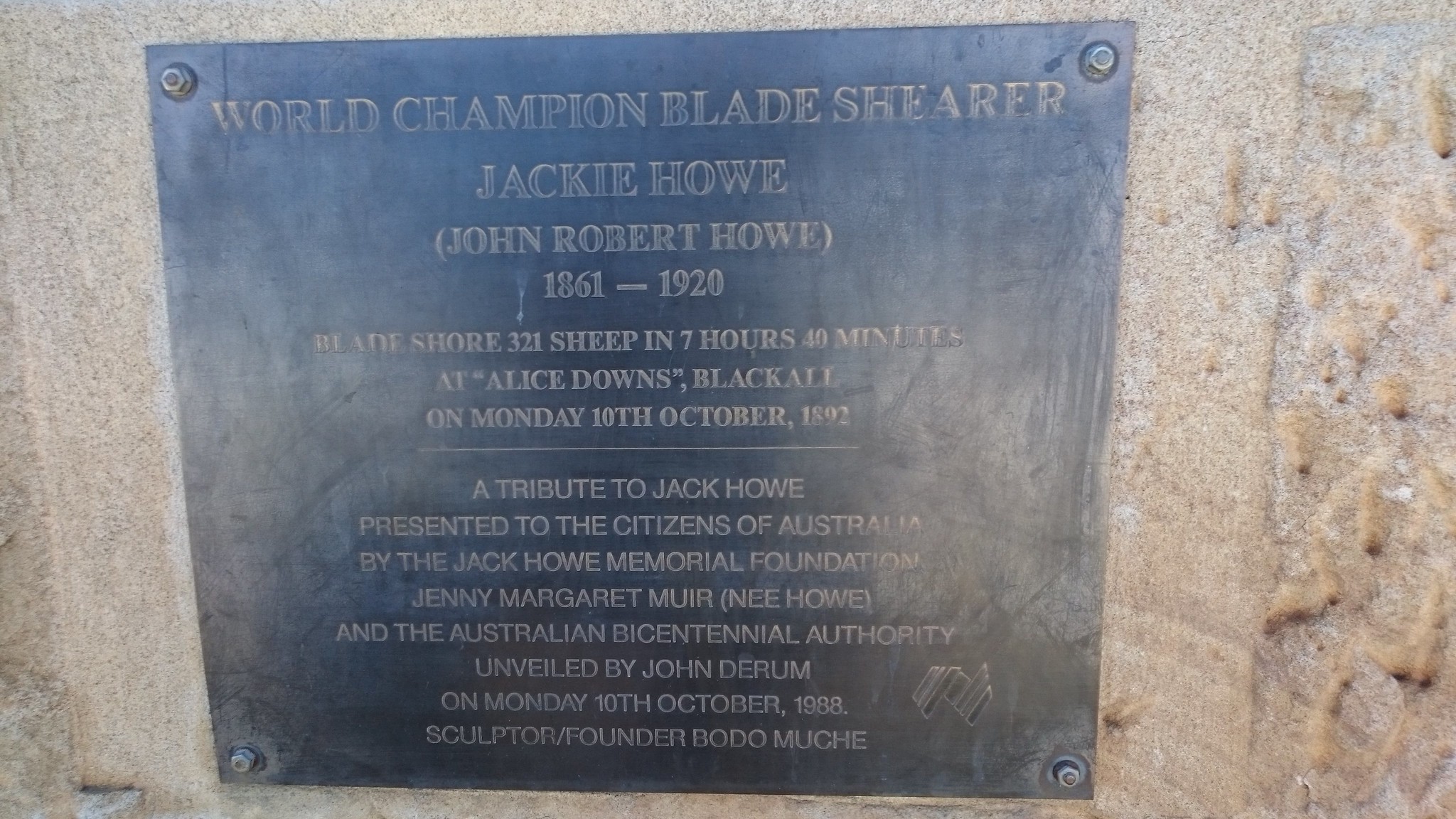
Jackie Howe, a step-brother to Annie (my great grandmother) and Will Chadbourne, in this connection, held the world's blade shearing record with a tally of 321 sheep in seven hours and forty minutes, which he accomplished at Alice Downs Station in 1892. Some of the old shearers, envious individuals probably, affirmed that the sheep shorn by Howe were all two-year-old maiden ewes, selected for that particular occasion. Be this as it may, it was a wonderful achievement on Howe's part to put through 321 sheep of any description at an aver-age of slightly more than 1 min. 37 secs. per sheep. Subsequently, at Barcaldine Downs, he used the machines for the first time, his initial effort being 276 sheep in eight hours.
Many feats, of endurance and skill are accredited to Jackie Howe in the Central West. It is asserted "that on one occasion he shore 100 sheep before dinner, rode a push bike 90 miles home before tea, tossed a packet of sweets into the woodheap for the children, and went in to kiss his wife with the swag still on his back."
During the 1898 shearing season Queensland's eighth Governor, Lord Lamington, paid a visit to the Central West, accompanied by Lady Lamington. The Vice-Regal party, whilst doing the rounds of a few of the principal stations in that locality, entered a shearing shed to see in action Jackie Howe, the shearer who put up the big tally some six years previously at Alice Downs Station. Howe, learning of the contemplated visit of the distinguished visitors to the shed, possessed himself of a piece of chalk, and whilst in conversation with her Ladyship, stooped down and marked her boots. Lady, Lamington questioned Howe as to the meaning of the procedure, and was informed that it was expected of her Ladyship to furnish the wherewithal to provide drinks for the shearers in the shed. A sovereign was accordingly handed Howe for that purpose.
Owing to the low price wool was commanding in the fifties, as com-pared with mohair, the Davidsons, of Canning Downs, imported to that station eight or nine llamas, with the object of testing the possibility of the successful raising of mohair on the Downs. However, the experiment did not meet with success. The llamas were eventually transferred to Eton Vale, and subsequently became non-existent. It was Jack Howe, sen., who undertook the first shearing of the llamas, shortly after their arrival from overseas, .and a queer experience was his lot. These animals have a habit of
expectorating a smellful saliva over anyone handling them roughly, as Jack found out to his cost. Before he could go on with the shearing the llamas had to be caught, tied down, and have a nose bag placed on them.
I last saw Jackie Howe, who held the world's blade shearing record, some 47 or more years ago. He was then on a hurried visit to Warwick, and attending an Eastern Downs Society's show, held on the old grounds in Guy-street.
Colonial history of the Darling Downs and my family connections to this....
Since the Leslie brothers led the pastoral advance into what became
Queensland in 1840, wool has made important contributions to the
Queensland economy. Through both their necessity and militancy, shearers
rose to the fore of bush workers in the late 19th century, and
Queensland produced the most famous exponent of the shearing boards in
the form of John (‘Jackie’) Howe. The son of a circus acrobat, Howe was
born at Killarney, near Warwick in 1861, and rose to fame in 1892 when
he set a world record by shearing 237 sheep by machine in a single day
at Barcaldine Downs. A week later he followed that feat by shearing 321
weaners in one day with blades at Alice Downs. Howe kept clippings of
his shearing career in this scrapbook, which extends beyond his
retirement from the boards in 1900. He later became a publican and as
President of the Blackall Workers’ Political Organisation played a major
role in the election of T.J. Ryan to parliament in 1909. His health
broken through years of hard work, Howe died at Blackall in 1920.
This is a showcase of early art and photographs of the Darling and Canning Downs. There is an early photograph of the Canning Downs Homestead to be seen there.
http://www.slq.qld.gov.au/showcase/grass-dukes-and-shepherd-kings
The Grass Dukes and the Shepherd Kings
Howe, John Robert (1861–1920)
This article was published in
Australian Dictionary of Biography, Volume 9, (MUP), 1983
John Robert
Howe (1861?-1920), shearer and publican, was born probably on 26 July 1861 at Killarney near Warwick, Queensland, son of John
Howe, circus acrobat turned stockman, and his wife Louisa, née Stokes, who had come to Queensland as a companion to the wife of
Patrick Leslie.
Howe
probably began shearing in the late 1870s and after a season in New
Zealand settled at Blackall. At the Roman Catholic church there on 24
April 1890 he married Margaret Alexandra Victoria Short.
Howe first achieved more than local fame
in 1892, when he shore 237 sheep by machine in one day at Barcaldine
Downs station early in October, and on the 10th shore 321 weaners with
the blades at Alice Downs. In the previous week he had shorn 1437 sheep
in 44 hours. An old shearing mate told how other shearers attempted to
slow him down by tickling him and jumping on his back, but his feats
were recognized by two gold medals, offered for shearing records by
Coleman & Sons, eucalyptus manufacturers of Cootamundra, and by the
presentation in January 1893 of an inscribed shearing machine from the
Wolseley Shearing Machine Co.
Howe was an enthusiastic member of the
Queensland Shearers' Union and prominent on its committee. In 1900 he
abandoned shearing and bought the Universal Hotel at Blackall. He moved
to the Barcoo Hotel in 1902 but repurchased the Universal in 1907 and
retained it until 1919. He remained a loyal member of the Australian
Labor Party and, as president of the Blackall Workers' Political
Organisation in 1909, took the lead in arranging for
T. J. Ryan
to stand for election to the Legislative Assembly. Late in life he
bought Sumnervale and Shamrock Park, pastoral properties near Blackall.
When he moved to Sumnervale in 1919 he was given the biggest send-off in
the town's history.
However his health was
already broken and he died aged 58 at Blackall on 21 July 1920. His
wife, six sons and two daughters survived him. He was buried in the
local cemetery.
An 'extraordinary physical specimen', Howe
weighed 18 stone (114 kg), with a 50 ins (127 cm) chest, 27½ ins (70
cm) thigh, 17 ins (43 cm) biceps and a hand the size of a small tennis
racket. He is reputed to have run 100 yards in eleven seconds in his
socks and to have been well above average in field events. He is also
known to have taken prizes for Irish dancing. He became a legend long
before he died and the flannel shirt worn by shearers is still widely
known as a 'Jackie Howe'.
Select Bibliography
-
P. J. Brixey, Jackie Howe: Australia's All Time Champion Blade Shearer (Warwick, Qld, 1982)
- Brisbane Courier, 13 Oct 1892
- Pastoral Review, 15 Oct 1892, 15 Nov 1894
- Catholic Advocate, 13 Apr 1916
- Worker (Brisbane), 5 Aug 1920
- private information.
Citation details
H. J. Gibbney, 'Howe, John Robert (1861–1920)', Australian
Dictionary of Biography, National Centre of Biography, Australian
National University,
http://adb.anu.edu.au/biography/howe-john-robert-6746/text11655,
published first in hardcopy 1983, accessed online 16 October 2015.
This article was first published in hardcopy in Australian Dictionary of Biography, Volume 9, (MUP), 1983
http://adb.anu.edu.au/biography/howe-john-robert-6746
ECHOES OF THE PAST
Jackie Howes Exploits to be transcribed ... TROVE
These extracts are just to give me some idea of the level
of settlement at the time

The following extract was in the MORETEN BAY COURIER 1848
 discussing the township of Warwick soon to be opened.

The former St Mary’s Church, the earliest sandstone
church in Warwick, was completed in 1865. It was
designed by prominent Brisbane architect, Benjamin
Backhouse, and constructed by C.A. Doran for around
£1,500. The roof was originally slated or shingled.
The church was officially opened in August 1865 by
Bishop Quinn, the first Bishop of Queensland. At this
time the church was named St Mary of Assumption,
now popularly shortened to St Mary’s. By 1867 a
Catholic School was established in the church. After
the opening of the new St Mary’s Church in 1926, this
building was partitioned, lined and used as school
rooms for the Catholic Primary School.
http://www.sdrc.qld.gov.au/ArticleDocuments/Heritage%20Trail%20Book.pdf.aspx?Embed=Y