Showing posts with label Bees. Show all posts
Sunday, April 12, 2015
I would say yes to 'HoNeY' on Tap!
This story about the awesome Honey on Tap Bee Hive is all over the internet.. They are crowd funding as well as selling these fantastic bee hives to the public. The father and son team have worked on this project for over ten years together perfecting it. Now its ready to unveil.
This has got to be an absolute boon for bees in the back yard. Pure honey in your own yard without disturbing the bees and there happiness sounds great to me.
READ MORE HERE
https://www.indiegogo.com/projects/flow-hive-honey-on-tap-directly-from-your-beehive
Images @ Eminpee Fotography
Labels:
Bees,
Hives,
Honey,
Inventions
URUNGA NSW
Urunga NSW 2455, Australia
Monday, October 14, 2013
The Bees are doing something different!
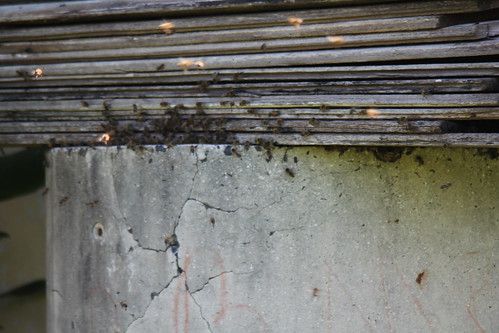
They have been here for a few months now and yesterday they decided to swarm on the outside of their chosen hive home here in my yard. I hope they are all fine, they look alright
During the first year of a queen's life the colony has little
incentive to swarm, unless the hive is very crowded. During her second
spring, however, she seems to be programmed to swarm. Without beekeeper
"swarm management" in the second year, the hive will cast a "prime
swarm" and may cast one to five "after swarms." The old queen will go
with the prime swarm, and other swarms will be accompanied by virgin queens.
It is considered good practice in beekeeping to reduce swarming as much as possible using several techniques. Allowing this form of reproduction often results in the loss of the more vigorous division. The remaining colony may be so depleted and set back due to the brood cycle interruption that it is unproductive for the season. Beekeepers control swarming prior to the natural swarm time. They may remove frames of brood comb making nucs (nucleus or starter colonies) or by shaking package bees (usually for sale) from hives.
Swarming is to the beekeeper what losing all of his calves is to a cattleman. Beekeepers try to anticipate swarming and assist the bees to reproduce in a more controlled fashion by "splitting hives" or making "nucs." This saves the "calves" and keeps the "cow" in condition to accomplish some work.
Old fashioned laissez-faire beekeeping depended upon the capture of swarms to replenish beekeeper colonies and early swarms were especially valued. An old English poem says:
More Information
There are various methods to capture a swarm. When the swarm first
settles down and forms a cluster it is relatively easy to capture the
swarm in a suitable box or nuc. There are also swarm traps with Nasonov pheromone
lures that can be used to attract swarms. One method that can be
employed on a sunny day when the swarm is located on a lower branch or
small tree is to put a white sheet under the swarm location.
A nuc box is put on the sheet. The swarm is sprayed from the outside with a sugar solution and then vigorously shaken off the branch. The main cluster, hopefully including the queen, will fall onto the white sheet and the bees will quickly go for the first dark entrance space in sight, which is the opening of the nuc. An organized march toward the opening will ensue and after 15 minutes the majority of bees will be inside the nuc. This capture method does not work at night though.
If the swarm is too embroiled in its perch so it cannot be dropped into a box or sheet, a skep can be suspended over it and gentle smoke used to "herd" the swarm into the skep.
Swarms may now be collected by a suction pump and the swarm will be sucked into a box. This way is easy and few bees are lost and none become angry.
Smoke is not recommended to calm a clustered swarm. Smoke will have the opposite effect on a clustered swarm as many bees will become agitated and fly about instead of settling down.
We watched them for ages and they looked happy enough although it had been very windy so perhaps this is why they are outside of their hive now. Merve said that I had accidentally created the perfect environment for a bee swarm to come and find this place and make it home. He said well done Sister.
Images @ Eminpee Fotography
Swarm management
| Why are they outside now? |
It is considered good practice in beekeeping to reduce swarming as much as possible using several techniques. Allowing this form of reproduction often results in the loss of the more vigorous division. The remaining colony may be so depleted and set back due to the brood cycle interruption that it is unproductive for the season. Beekeepers control swarming prior to the natural swarm time. They may remove frames of brood comb making nucs (nucleus or starter colonies) or by shaking package bees (usually for sale) from hives.
Swarming is to the beekeeper what losing all of his calves is to a cattleman. Beekeepers try to anticipate swarming and assist the bees to reproduce in a more controlled fashion by "splitting hives" or making "nucs." This saves the "calves" and keeps the "cow" in condition to accomplish some work.
Old fashioned laissez-faire beekeeping depended upon the capture of swarms to replenish beekeeper colonies and early swarms were especially valued. An old English poem says:
- A swarm of bees in May is worth a load of hay;
- A swarm of bees in June is worth a silver spoon;
- A swarm of bees in July isn't worth a fly.
| They really know I love them and they are safe here! |
More Information
Swarm capture
There are various methods to capture a swarm. When the swarm first
settles down and forms a cluster it is relatively easy to capture the
swarm in a suitable box or nuc. There are also swarm traps with Nasonov pheromone
lures that can be used to attract swarms. One method that can be
employed on a sunny day when the swarm is located on a lower branch or
small tree is to put a white sheet under the swarm location.A nuc box is put on the sheet. The swarm is sprayed from the outside with a sugar solution and then vigorously shaken off the branch. The main cluster, hopefully including the queen, will fall onto the white sheet and the bees will quickly go for the first dark entrance space in sight, which is the opening of the nuc. An organized march toward the opening will ensue and after 15 minutes the majority of bees will be inside the nuc. This capture method does not work at night though.
If the swarm is too embroiled in its perch so it cannot be dropped into a box or sheet, a skep can be suspended over it and gentle smoke used to "herd" the swarm into the skep.
Swarms may now be collected by a suction pump and the swarm will be sucked into a box. This way is easy and few bees are lost and none become angry.
Smoke is not recommended to calm a clustered swarm. Smoke will have the opposite effect on a clustered swarm as many bees will become agitated and fly about instead of settling down.
We watched them for ages and they looked happy enough although it had been very windy so perhaps this is why they are outside of their hive now. Merve said that I had accidentally created the perfect environment for a bee swarm to come and find this place and make it home. He said well done Sister.
Images @ Eminpee Fotography
Monday, September 02, 2013
Bully Big Corporations sue small entities out of sheer Fear to attempt to silence them.
Bayer has just sued the European Commission to overturn a ban on the pesticides that are killing millions of bees around the world. A huge public push won this landmark ban only months ago -- and we can't sit back and let Big Pesticide overturn it while the bees vanish.
Bayer and Syngenta, two of the world's largest chemical corporations, claim that the ban is "unjustified" and "disproportionate." But clear scientific evidence shows their products are behind the massive bee die-off that puts our entire food chain in peril.
Just last month, 37 million bees were discovered dead on a single Canadian farm. And unless we act now, the bees will keep dying. We have to show Bayer now that we won't tolerate it putting its profits ahead of our planet's health.
If this giant corporation manages to bully Europe into submission, it would spell disaster for the bees. Sign the petition to tell Bayer and Syngenta to drop their bee-killing lawsuits now.
The dangerous chemical Bayer makes is a neonicotinoid, or neonic. Neonics are soaked into seeds, spreading through the plant and killing insects stopping by for a snack. These pesticides can easily be replaced by other chemicals which don’t have such a devastating effect on the food chain. But companies like Bayer and Syngenta make a fortune from selling neonics -- so they’ll do everything they can to protect their profits.
The EU banned these bee-killers this past May, after a massive public campaign and a clear scientific finding from the European Food Safety Authority that neonics pose huge risks to bee populations. Bayer fought against the ban every step of the way, using tactics taken from Big Tobacco -- pouring millions into lobbying and fake science to stop decision-makers from taking action. Now, we have to defend this landmark ban for the bees, and our food supply.
Sign the petition (Find Petition here) now to tell Bayer and Syngenta to drop their aggressive lawsuits! We have to stand up for the European ban now, from Europe and from around the world. The current ban only lasts for two years before it's up for review, and Bayer is now determined to stop it before it even comes into force in December 2013.
If it is allowed to intimidate the European authorities with impunity, then the pressure to overturn the ban will be huge. This will be a massive victory for the poison industry, and a devastating loss for the bees, and all of us. It will make every environmental regulation more difficult, because companies that can't win on the facts can use their enormous profits to fund expensive, baseless lawsuits.
Bayer is an enormous company with a ton of public-facing brands. Neonics are a big part of its bottom line, but it can't afford poor publicity on a global scale.
If word gets out that Bayer is wrecking our ecosystem and threatening a creature responsible for pollinating a third of all our crops, the company will have to back down. Find Petition here
For more information on EU Insecticide ban triggers legal action click HERE
Images @ Eminpee Fotography
| Bayer Office North Sydney |
Bayer and Syngenta, two of the world's largest chemical corporations, claim that the ban is "unjustified" and "disproportionate." But clear scientific evidence shows their products are behind the massive bee die-off that puts our entire food chain in peril.
Just last month, 37 million bees were discovered dead on a single Canadian farm. And unless we act now, the bees will keep dying. We have to show Bayer now that we won't tolerate it putting its profits ahead of our planet's health.
If this giant corporation manages to bully Europe into submission, it would spell disaster for the bees. Sign the petition to tell Bayer and Syngenta to drop their bee-killing lawsuits now.
| The Pollinators in action |
The dangerous chemical Bayer makes is a neonicotinoid, or neonic. Neonics are soaked into seeds, spreading through the plant and killing insects stopping by for a snack. These pesticides can easily be replaced by other chemicals which don’t have such a devastating effect on the food chain. But companies like Bayer and Syngenta make a fortune from selling neonics -- so they’ll do everything they can to protect their profits.
The EU banned these bee-killers this past May, after a massive public campaign and a clear scientific finding from the European Food Safety Authority that neonics pose huge risks to bee populations. Bayer fought against the ban every step of the way, using tactics taken from Big Tobacco -- pouring millions into lobbying and fake science to stop decision-makers from taking action. Now, we have to defend this landmark ban for the bees, and our food supply.
Sign the petition (Find Petition here) now to tell Bayer and Syngenta to drop their aggressive lawsuits! We have to stand up for the European ban now, from Europe and from around the world. The current ban only lasts for two years before it's up for review, and Bayer is now determined to stop it before it even comes into force in December 2013.
If it is allowed to intimidate the European authorities with impunity, then the pressure to overturn the ban will be huge. This will be a massive victory for the poison industry, and a devastating loss for the bees, and all of us. It will make every environmental regulation more difficult, because companies that can't win on the facts can use their enormous profits to fund expensive, baseless lawsuits.
Bayer is an enormous company with a ton of public-facing brands. Neonics are a big part of its bottom line, but it can't afford poor publicity on a global scale.
If word gets out that Bayer is wrecking our ecosystem and threatening a creature responsible for pollinating a third of all our crops, the company will have to back down. Find Petition here
For more information on EU Insecticide ban triggers legal action click HERE
Images @ Eminpee Fotography
Labels:
Bayer,
Bees,
Europe,
Extinction event,
Law,
Monsanto,
Planet Health,
Syngenta,
WHO
URUNGA NSW
Urunga NSW 2455, Australia
Tuesday, February 19, 2013
My theory is the Mobile Telephone use has interupted the resonance of the animals of the planet.
Why did we ever think that pumping microwaves through our brain would be alright. Humanity has zero idea what this is doing to us. The jury is still out on this one. I for one, dislike to talk on these devices for extended periods of time. Because the youth are seeming to be born with these in our cultures at present, I do hold concerns about all of our children and mobile telephone use. We were all swept up in the fairy tale image of mobile communication when the technology opened up to the entire world. We didn't think. We are now 15 years down the track since the craze took off in this country and there is still no definitive proof that its safe.
Electrical tension and frequencies are very real and our planet has a frequency of 7.83Hz which is known as the Schumann resonance. Tension is discharged by lightening in the earths ionosphere cavity. The pulse of the earth is exactly 7.83Hz absolutely identical to the Alpha waves of the human brain. We are tuned into this identical pulse of life frequency.
Hans Berger used an EEG machine and made the first ever recording of the human brain, and he named these the Alpha waves. The brains frequency that controls our creativity, performance, emotions our stress our immune system and our entire being is tuned into the same frequency as the Earth. Berger and Schumann worked together on this after their separate discoveries in the onset.
The pulse of the Earth is the pulse of life itself. If this was a coincidence, it was natures most spectacular coincidence to come to light yet. There is a lot to be learned from this. The very minute change in oxygen in the blood is enough to kill a lot of bad stuff, using drugs is just another way we have been conned for a lot of reasons.
Not all medicine is bad. It is also what has happened in medicine with big pharmaceutical companies wielding the power once again with lots of money being flashed around to sell things in that are really not to our benefit as a human species.
SHUMANN
HANS BERGER
RICK WEAVER These are the men we need to thank for doing all of the research that shows what these resonances are in a scientific fashion for those less spiritual ones can see the hard evidence of what all indigenous cultures know by various names and in Australia it is in the Dreaming of the original people of the land. The land and them are one and the same. This connection is fully understood with these people. They do not need to use EEG machines, they know this is the fact.
Images @ Melopopzdropz Flickr
Electrical tension and frequencies are very real and our planet has a frequency of 7.83Hz which is known as the Schumann resonance. Tension is discharged by lightening in the earths ionosphere cavity. The pulse of the earth is exactly 7.83Hz absolutely identical to the Alpha waves of the human brain. We are tuned into this identical pulse of life frequency.
Hans Berger used an EEG machine and made the first ever recording of the human brain, and he named these the Alpha waves. The brains frequency that controls our creativity, performance, emotions our stress our immune system and our entire being is tuned into the same frequency as the Earth. Berger and Schumann worked together on this after their separate discoveries in the onset.
The pulse of the Earth is the pulse of life itself. If this was a coincidence, it was natures most spectacular coincidence to come to light yet. There is a lot to be learned from this. The very minute change in oxygen in the blood is enough to kill a lot of bad stuff, using drugs is just another way we have been conned for a lot of reasons.
Not all medicine is bad. It is also what has happened in medicine with big pharmaceutical companies wielding the power once again with lots of money being flashed around to sell things in that are really not to our benefit as a human species.
SHUMANN
HANS BERGER
RICK WEAVER These are the men we need to thank for doing all of the research that shows what these resonances are in a scientific fashion for those less spiritual ones can see the hard evidence of what all indigenous cultures know by various names and in Australia it is in the Dreaming of the original people of the land. The land and them are one and the same. This connection is fully understood with these people. They do not need to use EEG machines, they know this is the fact.
Images @ Melopopzdropz Flickr
Related articles
Cell Phones, Cancer, and Bee Colony Collapse
How Earth and humans are interlinked
Resonance - Beings of Frequency
Film: Resonance - Beings of Frequency
Tiniest planet yet found with sound
Emotions & Cognitive Dissonance: Your Supreme Divine Guidance
Why some people don't learn well: EEG shows insufficient processing of information to be learned
Turn On, Tune In... Drop Dead!
Alpha Activity And Learning Success
Resonance - Beings of Frequency (documentary film)
Labels:
Bees,
Earth,
Electricity,
Electromagnetic energy,
Hans Berger,
Homing devices,
Ocean,
Photography,
Schumann resonance
URUNGA NSW
North Coast, NSW, Australia
Subscribe to:
Posts (Atom)