. The author of which is said to be unknown however it has been sometimes attributed to German Alchemist Henricus Madathanus. It dates from the end of the 17th Century.
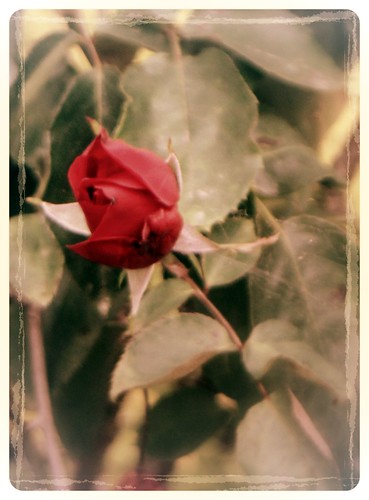
Paraboloa Allegory or The Parabola of Madathanus
As I once was walking in a beautiful, green, young forest, meditating
and deploring the difficulties of this life, considering how, through
the grievous Fall of our first Parents we came into such wretchedness
and grief, I left the accustomed road and came, I know not how, upon a
narrow footpath, very rough, untrodden, difficult and overgrown with so
many bushes and brambles that it was easy to see it was very seldom
used. At this I became frightened and wished to retrace my steps. But
this was not possible, especially since a strong wind blew so mightily
behind me that I had to take ten steps forward for every one I could
take backward. Therefore I had to press on, despite the roughness of the
way.
After advancing thus for a good while, I came at last to
a lovely meadow, encircled by beautiful fruit-laden trees, and called
by the inhabitants, The Field of the Blessed. Here I met a group of old
men with snow-white beards, and one among them was young and had a
pointed black beard. A still younger man was present also, whose name I
knew, but whose face I did not yet see. These men conversed about many
things, particularly about a high and great secret in Nature which God
kept hidden from the multitude, revealing it only to the few who loved
Him. I listened to them for a long time, and their words pleased me
much. But some among them appeared to mutter foolishly, indeed not about
the objectives or the work, but about Parabolas, Similitudes and other
Parergons. In this they followed the Figmenta of Aristotle, of Pliny and
of others, each of whom had copied from the other. At this I could no
longer remain silent, but put in a word of my own, answering many futile
things on the basis of experience, so that many listened to me,
examining me in their speciality, putting me to some very hard tests.
But my foundation was so good that I came through with all honors,
whereat they all were amazed. However they unanimously accepted me into
their Brotherhood, whereat I rejoiced heartily.
But they said
that I could not be a full colleague so long as I did not know their
Lion and was not fully aware what he could do internally and externally.
I was therefore to set about diligently to make him submissive to
myself. Confidently I promised them I would do my best, for I enjoyed
their company so much that I would not have parted from them for
anything in the world.
So they led me to the Lion and very
carefully described him to me. But what I was to do with him at first,
no one would tell me. Indeed some of them did give me certain hints, but
so confusedly that not one in a thousand could understand them.
However, when I had tied him and made certain that his sharp claws and
pointed teeth could not harm me, they no longer kept anything back. The
Lion was very old, fierce and huge; his yellow mane hung over his neck,
and he really appeared unconquerable. I was nearly terror-stricken, and
had it not been for my agreement and for the old men who stood around me
to see how I would begin, I would have run away. Confidently I
approached the lion in his cave and began to cajole him, but he looked
at me so sharply with his glittering eyes that I nearly let my water for
fear. At the same time I remembered that as we went to the Lion's cave
one of the old men had told me that many people had attempted to conquer
the Lion, but very few had succeeded. Since I did not wish to fail, I
recalled many grips I had learned through careful application to
athletics, and in addition I was well trained in natural magic, so I
forgot about the pleasantries and attacked the Lion so artfully and
subtly that before he was aware of it, I had pressed the blood out of
his body, indeed out of his heart itself. The blood was beautifully red,
but very choleric. But I examined his anatomy further and found many
things which greatly surprised me; his bones were white as snow, and
they were of greater quantity than his blood.
When my old men,
standing round the cave and watching me, realized what I had done, they
began to dispute with each other violently so that I could see their
gestures. But what they said I could not understand because I was so far
inside the cave. And when they began to shout at each other, I heard
one who cried, "He must also bring the Lion to life again; otherwise he
cannot be our colleague."
I did not wish to make trouble.
Therefore I walked out of the cave and crossed a broad space. Then I
came, I do not know how, to a very high wall which rose over a hundred
ells into the clouds. But above there it did not have the width of a
shoe. From the beginning where I started, to the end there ran an iron
railing along the top of the wall, well fastened with many supports. I
walked along the top of this wall and thought I saw someone going along a
little ahead of me on the right side of the railing.
After I
followed him a while, I saw someone following behind me on the other
side of the railing (to this day I don't know whether it was a man or a
woman) who called to me and said that it was better to walk on his side
than where I was going. I easily believed this, for the railing which
stood in the middle of the wall made the passageway very narrow so that
it was difficult to walk along it at such a height. Then behind me I saw
some people who wanted to go that same way. So I swung myself under the
railing, holding it fast with both hands, and continued along the other
side until I came to a place on the wall where it was especially
dangerous to descend. Now I regretted that I had not remained on the
other side; for I could not pass under the railing again; also it was
impossible to turn back and take the other way again. Therefore I
summoned my courage, trusted in my sure-footedness, held on tightly, and
descended without harm. When I went on for a while, I had indeed
forgotten about all dangers and also did not know where the wall and
railing had vanished.
After I had descended I saw standing a
lovely rosebush on which beautiful red and white roses were growing; but
there were more of the red than of the white. I broke off some of them
and put them on my hat.
I soon saw a wall encircling a great
garden, in which were young fellows. Their maidens also would have liked
to be in the garden, but they did not wish to make the great effort of
walking the long distance around the wall to the gate. I was sorry for
them and returned the whole distance I had come, then followed a
smoother path, and I went so fast that I soon came to several houses,
where I hoped to find the cottage of the gardener. There I found many
people; each had his own room; often two were working together slowly
and diligently; but each had his own work. And it appeared to me that
all this they were doing, I had done before them, and that I knew it all
very well. Then I thought, "Look, if so many other people do such dirty
and slovenly work only for appearance's sake, and each according to his
own ideas, but not established in Nature, then you yourself are
forgiven." Therefore I would not stay there any longer for I knew that
such art would disappear in smoke, so I continued on my destined way.
As I now went toward the garden gate some looked at me sourly, and I
feared that they would hinder me in the fulfillment of my intentions.
Others, however, said, "See, he wishes to go into the garden; but we who
worked for so long in its service have never entered it. We shall laugh
at him if he blunders."
But I paid no attention to them, for I
knew the plan of the garden better than they, although I had never been
in it, and I went straight up to the gate. This was locked fast, and
one could not discover even a key-hole from the outside. But in the gate
I saw a tiny round hole which one could not distinguish with ordinary
eyes, and I thought it was necessary to open the gate there. I took out
my skeleton-key, especially prepared for this purpose, unlocked the gate
and walked in.
After I was inside the gate I found more
locked gates, but I unlocked them without more difficulty. But I found
that this was a hallway as if it were in a well-built house, about six
shoes wide and twenty long, covered with a ceiling. And although the
other gates were still locked, I could see through them sufficiently
into the garden as soon as the first gate was opened.
And so
in God's Name I wandered further into the garden. There in the midst of
it I found a little flower-bed, square, each of its four sides six
measuring-rods long, and covered with rosebushes, on which the roses
were blossoming beautifully. Since it had rained a little and the sun
was shining, a very lovely rainbow appeared. After I left the flower-bed
and had come to the place where I was to help the maidens, behold!
instead of the walls there stood a low wattled fence. And the most
beautiful maiden, dressed all in white satin, with the most handsome
youth, clad in scarlet, went past the rose-garden, one leading the other
by the arm and carrying many fragrant roses in their hands. I spoke to
them, asking how they had come over the fence.
"My dearest
bridegroom here helped me over," she said, "and now we are leaving this
lovely garden to go to our room to be together." "I am happy," I
replied, "that without further effort of mine you can satisfy your wish.
Nevertheless you can see how I ran so long a way in so short a time,
only to serve you."
After this I came into a great mill, built
within stone walls; inside were no flour-bins nor any other things
necessary for milling; moreover, through the wall one saw no waterwheels
turning in the stream. I asked myself how this state of affairs came
about, and one old miller answered me that the milling-machinery was
locked up on the other side. Then I saw the miller's helper go into it
by a covered passage-way, and I followed close after him. But as I was
going along the passage, with the waterwheels on my left, I paused,
amazed at what I saw there. For now the waterwheels were above the level
of the passage, the water was coal-black, although the drops from it
were white, and the covered passage-way itself was not more than three
fingers wide. Nevertheless I risked turning back, holding fast to the
beams over the passage-way; thus I crossed over the water safely. Then I
asked the old miller how many waterwheels he had. He answered, Ten.
This adventure I long remembered and dearly wished I could know what it
meant. But when I saw that the miller would not reveal anything, I went
on my way.
In front of the mill there arose a high, paved
hill; on its summit some of the old men I have mentioned were walking in
the warm sunshine. They had a letter from the Brotherhood and were
discussing it among themselves. I soon guessed its contents, and that it
might concern me, so I went to them and asked, "Sirs, does what you
read there concern me?"
"Yes," they replied, "Your wife whom
you recently married, you must keep in wedlock or we shall have to
report it to the Prince."
I said, "That will be no trouble,
for I was born together with her, as it were, was raised with her as a
child, and because I have married her I shall keep her always, and death
itself shall not part us. For I love her with all my heart."
"What have we to complain of, then?" they asked; "the bride is also
happy, and we know her wish is that you must be joined together."
"I am very happy," I replied.
"Well then," said one of them, "the Lion will come back to life, mightier and more powerful than before."
Then I recalled my previous struggle and effort, and for some curious
reason I felt this did not concern me but another whom I knew well. At
that moment I saw our bridegroom walking with his bride, dressed as
before, ready and prepared for the wedding, whereat I was very happy;
for I had greatly feared that these things might concern me.
When, as has been said, our scarlet-clad bridegroom came to the old men
with his dear bride, her white garments gleaming brightly, they were
soon united and I greatly wondered that the maiden who might be the
bridegroom's mother was nevertheless so young that she seemed newly
born, as it were.
Now I do not know how the two had sinned;
perhaps as brother and sister, united in love in such a way that they
could not be separated, they had been accused of incest. Instead of a
bridal bed and brilliant wedding they were condemned to a strong and
everlasting prison. However, because of their noble birth and station,
in order that they could do nothing together in secret, and so all their
doings would always be visible to their guard, their prison was
transparent-clear like crystal and round like a heavenly dome. But
before they were placed inside, all the clothing and jewels they wore
were taken from them so they had to live together stripped naked in
their prison. No one was assigned to serve them, but all their
necessities of food and drink -- the latter drawn from the stream
mentioned above -- were placed inside before the door of the room was
securely closed, locked, sealed with the seal of the Brotherhood, and I
was placed on guard outside. And since winter was near I was to heat the
room properly so they would neither freeze nor burn, but under no
conditions could they come out of the room and escape. But if any harm
resulted from my neglect of these instructions, I would undoubtedly
receive great and severe punishment.
I did not feel well about
this, my fear and worry made me faint-hearted, and I thought to myself,
It is no small task which has been assigned to me. I also knew that the
Brotherhood did not lie, always did what it said, and certainly
performed its work with diligence. However, I could change nothing, and
besides, the locked room was situated in the midst of a strong tower,
encircled by strong bulwarks and high walls, and since one could warm
the room by a moderate but constant fire, I took up my task in God's
Name, beginning to heat the room in order to protect the imprisoned
married couple from the cold. But what happened? As soon as they felt
the faintest breath of warmth, they embraced each other so lovingly that
the like of it will not be seen again. And they remained together in
such ardor that the heart of the young bridegroom disappeared in burning
love, and his entire body melted and sank down in the arms of his
beloved. When the latter, who had loved him no less than he had loved
her, saw this, she began to lament, weeping bitterly over him and, so to
say, buried him in such a flood of tears that one could no longer see
what had happened to him. But her lamenting and weeping lasted only for a
short time, for because of her great heart-sorrow she did not wish to
live longer, and died of her own free will. Ah, woe is me! In what
anxiety, grief and distress was I when I saw those two I was to have
helped, dissolved entirely to water and lying before me dead. Certain
failure was there before my eyes, and moreover, what to me was the
bitterest, and what I feared most were the coming taunts and sneers, as
well as the punishment I would have to undergo.
I passed a few
days in careful thought, considering what I could do, when I recalled
how Medea had restored the corpse of Jason to life, and so I asked
myself, "If Medea could do it, why cannot you do it also?" Whereat I
began to think how to proceed with it, but I did not find any better
method than to maintain a steady warmth until the water would recede and
I could see the dead bodies of the lovers once again. Then I hoped that
I would escape all danger to my great gain and praise. Therefore for
forty days I continued with the warmth I had begun, and I saw that the
longer I did this, the more the water disappeared, and the dead bodies,
black as coal, came to view. And indeed this would have happened sooner
had not the room been locked and sealed so tightly. But under no
conditions dared I open it. Then I noticed quite clearly that the water
rose high toward the clouds, collected on the ceiling of the room, and
descended again like rain; nothing could escape, so our bridegroom lay
with his beloved bride before my eyes dead and rotten, stinking beyond
all measure.
Meanwhile, I saw in the room a rainbow of the
most beautiful colors, caused by the sunshine in the moist weather,
which heartened me no little in the midst of my sorrows. And soon I
became rather happy that I could see my two lovers lying before me.
However, no joy is so great that sorrow is not mixed with it; therefore
in my joy I was sorrowful because I saw the ones I was to have guarded
lying lifeless before me. But since their room was made from such pure
and solid material and was shut so tightly, I knew that their soul and
their spirit could not escape, but were still enclosed in it, so I
continued with my steady warmth day and night, carrying out my duty as
prescribed, for I believed that the two would not return to their bodies
so long as the moisture was present. This I indeed found to be true.
For in many careful observations I observed that many vapors arose from
the earth about evening, through the power of the sun, and ascended on
high as if the sun itself were drawing up the water. But during the
night they gathered into a lovely and fertile dew, descending very early
in the morning, enriching the earth and washing the corpses of our
dead, so that from day to day, the longer such bathing and washing
continued, they became even whiter and more beautiful. But the more
beautiful and whiter they became, the more they lost their moisture,
until at last when the air became light and clear and all the foggy,
damp weather had passed, the spirit and soul of the bride could no
longer remain in the pure air, and returned into the transfigured,
glorified body of the Queen, and as soon as the body felt their
presence, it instantly became living once again. This brought me no
little joy, as one can easily imagine, especially as I saw her arise,
dressed in a very rich garment, the like of which very few on this earth
have seen, wearing a costly crown, adorned with perfect diamonds, and
heard her say; "Harken, you children of men, and learn, all of you who
are of women born, that the All-Highest has power to enthrone kings and
to dethrone them. He makes rich and poor, according to his will. He
kills and makes to live again. And all this behold in me as a living
example! I was great and I became small. But now after I became humble, I
have been made queen over many realms. I was killed and am resurrected
again. To me, the poor one, have the great treasures of the wise and
mighty been entrusted and given. Therefore have I been given power to
make the poor rich, to extend mercy to the humble, and to bring health
to the sick. But not yet am I like my dearest brother, the great, mighty
king, who will also be awakened from the dead. When he comes he will
prove that my words are true."
And as she said this, the sun
shone brightly, the days became warmer, and the dog-days were near at
hand. But long before the sumptuous and great wedding of our new queen
many costly robes were prepared from black velvet, ash-grey coloured
damask, grey silk, silver-coloured taffeta, snow-white satin; indeed, a
silver piece of extraordinary beauty, embroidered with costly pearls and
worked with marvellous, clear-sparkling diamonds was also made ready.
And robes for the young king were also made ready, namely of pink, with
yellow aureolin colours, costly fabrics, and finally a red velvet
garment adorned with costly rubies and carbuncles in very great numbers.
But the tailors who made these garments were invisible, and I marveled
when I saw one coat after another, and one garment after another being
finished, for I knew that no one except the bridegroom and his bride had
entered into the chamber. But what astonished me the most was that as
soon as a new coat or garment was finished, the former ones disappeared
from before my eyes, and I did not know where they had gone or who had
locked them away.
And after this costly coat was made ready,
the great and mighty king appeared in all his power and glory, and there
was nothing like him. And when he discovered he was locked in, he asked
me in a friendly manner and with gracious words to open the door for
him so he would be able to come out; he said it would result in great
blessing for me. Although I was strictly forbidden to open the room, I
was so overwhelmed by the great appearance and the gentle persuasive
powers of the king that I opened the door willingly. And as he walked
out, he was so friendly, gracious, even humble, that one could indeed
see that nothing graces noble persons so much as do these virtues. And
since he had passed the dog-days in the great heat, he was very thirsty,
weak and tired; and he asked me to bring him some of the fast-flowing
water from beneath the waterwheels of the mill, which I did, and he
drank it with great eagerness. Then he returned to his chamber and told
me to lock the door fast behind him, lest someone should disturb him or
waken him from his sleep. There he rested for a few days, and then he
called me to open the door. But I saw that he had become much more
handsome, full-blooded and splendid, and he also noticed it; and he
thought that the water was marvelous and healthy.
Therefore he
asked for more, and drank a larger quantity than he had the first time,
and I resolved to enlarge the chamber. After the king had drunk his
fill of this wonderful beverage which the ignorant do not value at all,
he became so handsome and glorious that in all my life I never saw a
more splendid appearance, or anyone more noble in manner and character.
Then he led me into his kingdom and showed me all the treasures and
riches of the world, so that I must say that not only did the queen
speak the truth, but he also gave the greatest part of it to those who
know the treasure and can describe it. There were gold and precious
carbuncle stones without end, and the rejuvenation and restoration of
the natural powers, as well as the recovery of health and the removal of
all illnesses were daily occurrences there. But most delightful of all
in this kingdom was that the people knew, reverenced and praised their
Creator, receiving from Him wisdom and knowledge, and at last, after
this happiness in the world of time, they attained an eternal
blessedness. To this may God, Father, Son and Holy Spirit help all of
us.
The Chymical Wedding deals with the journey of initiation of an unknown
narrator, who, after many trials, enters the Rose Garden and bears
witness to the dissolution and reconstitution of a pair of royal lovers
into a King and Queen.
Like
The Chymical Wedding, the
Parabola Allegory has the haunting quality of a dream. It was taken as the starting point by Viennese psychologist
Herbert Silberer for an analysis of Freudian dream interpretation, in his major work
Problems Of Mysticism And Its Symbolism where the Allegory is quoted in full.
Silberer interprets the Allegory along
Freudian
lines then, pointing out the limitations of such an approach, goes on
to interpret the narrative along alchemical/mystical lines, placing the
story in the context of the
Mystery traditions of the world's religions as an allegory of the
Unio Mystica.
The Unio Mystica is the same term "mysticism". It has Ancient Greek origins with various historically determined meanings. Derived from the Greek word μυω, meaning "to conceal", mysticism referred to the biblical liturgical, spiritual, and contemplative dimensions of early and medieval Christianity during the early modern period,
the definition of mysticism grew to include a broad range of beliefs
and ideologies related to "extraordinary experiences and states of
mind"
Rosicrucianism is a philosophical secret society said to have been founded in late medieval Germany by Christian Rosenkreuz.
It holds a doctrine or theology
"built on esoteric truths of the ancient past", which, "concealed from
the average man, provide insight into nature, the physical universe and
the spiritual realm." Rosicrucianism is symbolized by the Rosy Cross or Rose Cross.
The Early modern period - This period follows the late Middle Ages of the post-classical era.
The time limits of this period are still debatable, spanning the period after the last part of the
post-classical age around the 1500. This time was known as the Middle Ages. through the
beginning of the Age of Revolutions (c. 1800) and is variously
demarcated by historians as beginning with the Fall of Constantinople in
1453, with the Renaissance period, and with the Age of Discovery
(especially with the discovery of America by Christopher Columbus in
1492, but also with the discovery of the sea route to the East in 1498),
and ending around the French Revolution in 1789. From Wikipedia
Images @ Eminpee Fotography


